Gold Performance Capstone: Audit a Claim from Signal Ledger to Account Equity
Reconcile gross and net trade results with open P&L, cash flows and evidence labels before evaluating a public performance claim.
Begin with the exact claim and its reporting boundary
A claim such as successful gold signals can refer to target touches, completed paper trades, broker fills or net account returns. These are different objects. Ask for the definition of success, date range, instrument, rule version, event population and data source before examining the headline percentage. A chart showing a target level does not establish that an order entered, filled its requested size and exited there. This capstone joins the course’s accounting and evidence lessons into one review process. The aim is a traceable report rather than a verdict based on a persuasive screenshot.
Reconcile a deliberately small closed-trade ledger
Use invented gross completed-trade results of +300, +100, −100 and −200 dollars. Gross net is +100 and gross profit factor 400/300, approximately 1.3333. Assume USD 10 of costs for each trade, producing net results +290, +90, −110 and −210. Closed net total is +60 and net profit factor 380/320=1.1875. These are the same four trades viewed through explicit cost conventions. Keep the entry and exit evidence for each row, including partial fills and actual execution timestamps. A public claim should not mix gross targets for winners with net realized losses for losers.
Add open exposure and deposits without calling them profit
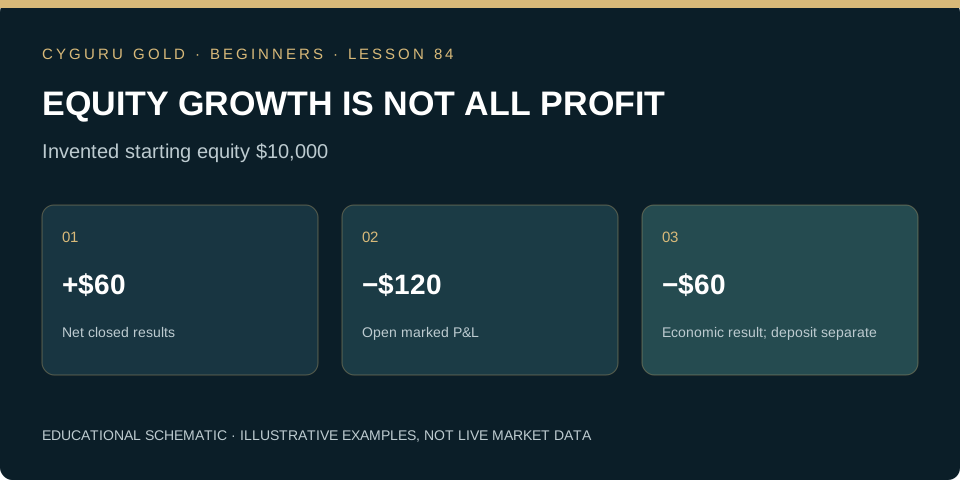
Assume starting equity USD 10,000, an external deposit of USD 500 and an open marked loss of USD 120 at the reporting cutoff. With the +60 closed net result and no other items, ending equity is 10,000+500+60−120=USD 10,440. The economic P&L over the stated mark convention is −USD 60, not the USD 440 increase in equity and not merely the +USD 60 closed result. Deposit timing is needed for a proper percentage-return calculation; dividing by one convenient balance is insufficient. The open mark’s source and quote-side convention must also be documented.
| Item | USD | Classification |
|---|---|---|
| Starting equity | 10000 | Opening capital |
| Deposit | +500 | External flow |
| Closed net result | +60 | Economic P&L |
| Open marked result | −120 | Economic P&L |
| Ending equity | 10440 | Closing capital |
| Economic result | −60 | Deposit excluded |
Match every evidence label to what was actually observed
Historical backtest output is hypothetical. A forward paper event log is a record of generated decisions under its simulated execution assumptions. A broker fill record establishes an executed quantity and price within that account, while an account statement helps reconcile capital and cash flows. None should be relabeled as another without supporting evidence. Preserve rejected, canceled, duplicate and unresolved events in the appropriate operational ledger, while keeping them distinct from completed economic trades. If a target was touched on a bar containing an ambiguous entry or stop sequence, mark the uncertainty rather than selecting the most favorable interpretation.
Assess uncertainty, comparability and missing risks
Four completed trades cannot establish a stable win probability, a dependable Sharpe ratio or the long-run tail risk of the strategy. Compare benchmark periods, currency, exposure, costs and cash conventions before claiming outperformance. Ask whether failed versions or unfavorable periods were omitted and whether a reported statistic was selected after many experiments. A correct reconciliation is necessary evidence, but it is not sufficient proof of a durable edge. Include stress, liquidity and operational limits that the sample did not exercise. State clearly which conclusions the records support and which require more representative independent observation.
Practice task: deliver a claim-review memo
Produce the four-row gross-to-net ledger, both profit factors, the +60 closed result, −120 open mark and final 10,440 equity after the 500 deposit. Verify the −60 economic P&L. Add a field for every evidence type and an unresolved-questions section covering missing fills, open valuation, deposit timing and strategy versions. Finish with a rewritten claim that describes only the supported historical or hypothetical observations, without guarantees or invented success probabilities. A reader should be able to reproduce every total and understand the remaining uncertainty before treating the report as useful evidence about a gold trading process.
Can you apply the idea?
Answer three questions, then check the explanation for every answer. You can repeat the check after reviewing the lesson.
Knowledge check: not attempted
Make this lesson part of your process.
Finish the reading and its practice task, then mark the lesson as completed.
0 of 100 lessons completed
Gold Trading Mastery
From gold market fundamentals to technical analysis, execution, quantitative research and AI. A structured 160-chapter course.
Explore the book →Continue the beginner course
What Is XAU/USD? Gold Trading Explained for Beginners →
How to Read Gold Candlestick Charts: A Beginner’s Guide →
Market, Limit and Stop Orders in Gold Trading →
Gold Trading Costs: Spread, Slippage and Financing →
Stop-Loss and Take-Profit in Gold: Beginner Essentials →
Your First Gold Trading Plan: Practise Before Going Live →
Gold Position Sizing: Calculate Exposure Before You Trade →
Gold Leverage and Margin: Understand the Difference →
Support and Resistance in Gold: Read Zones Without Guessing →
Gold and the Economic Calendar: CPI, Jobs and the Fed →
Multiple-Timeframe Gold Analysis: Context, Setup and Trigger →
Gold Trading Expectancy: Evaluate Results Beyond Win Rate →
Gold Trends and Ranges: Identify the Market Before the Setup →
Gold ATR for Beginners: Measure Movement, Not Direction →
Gold Breakouts and Failed Breaks: Define the Evidence →
Gold Trading Drawdown: Understand Losses and Recovery →
How to Backtest a Gold Trading Rule Without Hindsight →
The Gold Pre-Trade Checklist: Turn a Plan into a Decision →
Gold Liquidity and Trading Sessions: Study the Conditions →
Audit a Gold Trade: Quotes, Triggers and Actual Fills →
Multiple Gold Positions: Measure the Combined Exposure →
Partial Exits and Breakeven Stops: Follow the Arithmetic →
Small Samples in Gold Trading: Describe the Uncertainty →
Your Gold Trading Review: Version the Rule Before Testing Again →
Gold Weight and Purity: Calculate the Fine Gold Content →
Gold Premiums and Buyback: Calculate the Round-Trip Hurdle →
Allocated and Unallocated Gold: Understand the Ownership Claim →
Gold Benchmarks and Spot Quotes: Compare Like with Like →
Gold Returns in Your Currency: Separate Metal and FX Effects →
Gold Futures Tick Value: Translate Price Moves into Money →
Gold Futures Daily Settlement: Follow the Cash Through the Account →
Gold COT Reports: Read Positioning Without Inventing a Signal →
Gold ETFs: NAV, Market Price and Tracking Difference →
Gold in a Portfolio: Calculate Weight Drift and Rebalancing →
Gold Moving Averages: Read Smoothing Without Predicting the Future →
Gold RSI: Momentum Is Not a Reversal Promise →
Gold Volume: Distinguish Ticks, Contracts and Coverage →
Gold Heikin Ashi Charts: Separate Display Prices from Fills →
Gold Indicator Repainting: Distinguish Live Signals from Confirmed History →
Gold Backtests: When One Candle Touches Both Stop and Target →
Gold TradingView Alerts: Audit the Saved Script Snapshot →
Gold Signal Webhooks: Verify Delivery, Freshness and Duplicates →
Gold Trading Returns: Add Money, Compound Percentages →
Gold Account Performance: Separate Deposits from Trading Gains →
Gold Realized Volatility: Calculate the Statistic and Audit Its Assumptions →
Gold Correlation: Align Returns Before Interpreting the Relationship →
Gold Event Studies: Measure the Reaction Without Inventing the Cause →
Gold Strategy Robustness: Count the Experiments Behind the Winner →
Gold Stress Tests: Model Gaps, Liquidity and Tail Losses Together →
Gold Options at Expiry: Separate Payoff, Premium and Exercise →
Gold Option Delta and Gamma: Estimate Exposure Without Freezing It →
Gold Implied Volatility: Separate the Price of Uncertainty from Direction →
Gold Futures Rolls: Reconcile Contract P&L with a Continuous Chart →
Gold Mining Shares: Understand the Business Behind the Metal Exposure →
Gold VWAP: Define the Anchor, Price Input and Volume →
Gold Bollinger Bands: Distinguish Price Dispersion from a Reversal Signal →
Gold MACD: Read the Line, Signal and Histogram as Different Comparisons →
Gold Donchian Channels: Use the Prior Window Without Circular Signals →
Gold Fibonacci Retracements: Audit the Anchors Before Trusting the Level →
Gold Position Accounting: Distinguish Net Exposure from Gross Tickets →
Gold Bracket Orders: Audit Partial Fills and Cancellation States →
Gold Trade Excursions: Measure MAE and MFE Without Rewriting the Past →
Gold Execution Shortfall: Reconcile Decisions, Fills and Unfilled Quantity →
Gold Strategy Monitoring: Separate Data Failures, Execution Drift and Method Decay →
Gold Open Interest: Follow the Contract Ledger Before Reading Sentiment →
Gold Order Books: Translate Displayed Depth into a Conditional Fill Estimate →
Gold Calendar Spreads: Calculate Relative-Maturity P&L and Leg Risk →
Gold Basis Risk: Explain Why a Futures Hedge Can Leave a Residual Loss →
Gold Lending and Lease Rates: Separate Metal Interest from Price Exposure →
Gold Assay and Authenticity: Separate a Purity Calculation from Evidence →
Gold Storage and Insurance: Reconcile the Inventory and the Protection →
Gold Inventory Hedging: Match Fine Ounces and Finance the Cash Path →
Gold and Currency Hedging: Separate Metal Exposure from the Conversion Leg →
Gold Capstone: Build One Report from Price, Basis, Costs and Liquidity →
Gold Profit Factor: Reconcile the Winning and Losing Dollars →
Gold Sharpe Ratios: Align Excess Returns, Frequency and Risk →
Gold Sortino Ratios: Define the Target and the Downside Denominator →
Gold Win Rates: Calculate a Confidence Interval and State Its Assumptions →
Gold Return Dependence: Keep the Sequence When Measuring Risk →
Gold Bootstrap Studies: Resample the Evidence Without Inventing New Markets →
Gold Walk-Forward Tests: Freeze Each Rule Before Its Next Evaluation →
Gold Research Universes: Keep Delisted Products and Historical Eligibility Visible →
Gold Performance Attribution: Separate Within-Condition Results from the Opportunity Mix →
Build a Gold Trading System: Write the Operating Charter Before the Signal →
Gold Setup Rules: Translate Chart Language into Testable Predicates →
Gold System States: Separate Eligibility, Submission, Exposure and Rearming →
Gold System Sizing: Reserve Risk and Check Whether a Trade Is Feasible →
Gold System Exits: Define Priority, Timeouts and Conflicting Events →
Release a Gold Paper System: Test the Runbook Before Increasing Exposure →
Gold Execution Hesitation: Distinguish a Missed Entry from a New Decision →
Gold Overtrading: Audit Eligibility Before Counting Activity →
Gold Losing Streaks: Prevent Recovery Pressure from Rewriting Risk →
Gold Rule Changes: Separate Emergency Repairs from Strategy Redesign →
Gold Trading Journals: Score Decision Quality Separately from Profit →
Gold Case Study: Audit a Trend-Continuation Trade from Context to Net Exit →
Gold Case Study: Accept a Failed Range Break Without Moving the Evidence →
Gold Case Study: Document a Valid No-Trade Decision Around a Scheduled Event →
Gold Case Study: Recover from a Lost Order Response Without Duplicating Exposure →
Gold Lesson 100: Complete the Paper-System Project and Defend Its Evidence →
Market Desk and position-risk calculator →
Position sizing explained → · Build a trading journal →
Lesson sources and further study
Investor.gov: Evaluating performance claims
Core course references
CME Group: Gold Product Overview. Investor.gov: Types of Orders explains order concepts for stocks; check the execution rules of your specific gold instrument.
Gabriel Nicolaev — CyGuru · Published 7 November 2026. Educational material. Illustrative prices are not current quotes or trade recommendations.