Gold Liquidity and Trading Sessions: Study the Conditions
Compare gold execution conditions across sessions without assuming that a named session guarantees a good trade.
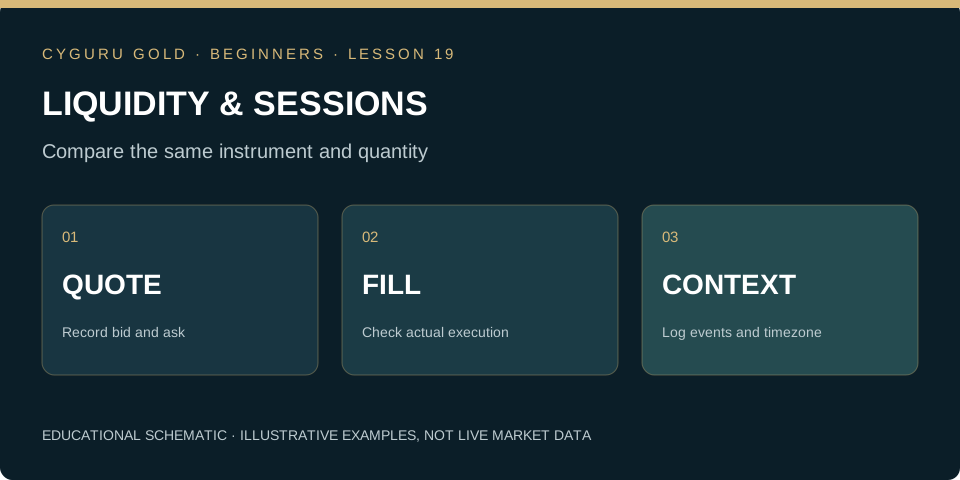
A session is a context, not an entry signal
A session label describes a period of market activity. It does not establish that the same setup has the same execution characteristics throughout that period. Gold instruments trade through different venues and provider arrangements. Exchange-listed futures and a broker’s over-the-counter product can have different hours, breaks and quote behavior. Before using a session filter, record the exact instrument, provider and date-specific timezone. A broad label such as London morning is too ambiguous for a repeatable comparison.
Distinguish available quantity from movement
Liquidity concerns executable trading interest at relevant prices and quantities. Volatility concerns price variation. A fast-moving chart does not by itself reveal how much your order could fill at one price. Likewise, quiet-looking candles do not guarantee a narrow spread. Compare the displayed bid and ask, executed quantities and actual fills where those observations are available. A chart made from a single price reference cannot reconstruct all the information needed to evaluate execution quality.
Compare costs in the same units
Suppose two hypothetical windows have spreads of USD 0.40 and USD 1.20 per ounce. At five ounces, an immediate round trip at unchanged quotes implies USD 2 and USD 6 of spread difference respectively, before other charges. These are teaching inputs, not typical session spreads. If a method seeks a small price movement, that difference can materially change its net result. Record commissions and holding charges separately so the comparison does not double-count costs already included in the fills.
Treat transitions and scheduled events explicitly
Session overlaps, venue breaks, holidays and economic announcements can alter the conditions you are observing. Their effect must be measured for the instrument being studied rather than assumed from a general timetable. A date-specific calendar matters because clock changes can alter local conversions. Define whether a transition window is eligible, observation-only or outside the practice plan. Do not replace the documented rule merely because the latest candle looks unusually attractive.
Practice task: build a conditions log
Choose two clearly defined observation windows and collect the same fields over several dates: source timezone, local conversion, bid, ask, spread, relevant events and any actual execution differences. Use comparable quantities and distinguish observed quotes from simulated fills. Summarize variation as well as averages; one unusually cheap window does not establish a dependable pattern. The purpose is to identify assumptions worth testing, not to declare a universally best time to trade. Continue with the execution-audit lesson to inspect individual orders.
Can you apply the idea?
Answer three questions, then check the explanation for every answer. You can repeat the check after reviewing the lesson.
Knowledge check: not attempted
Make this lesson part of your process.
Finish the reading and its practice task, then mark the lesson as completed.
0 of 24 lessons completed
Gold Trading Mastery
From gold market fundamentals to technical analysis, execution, quantitative research and AI. A structured 160-chapter course.
Explore the book →Continue the beginner course
What Is XAU/USD? Gold Trading Explained for Beginners →
How to Read Gold Candlestick Charts: A Beginner’s Guide →
Market, Limit and Stop Orders in Gold Trading →
Gold Trading Costs: Spread, Slippage and Financing →
Stop-Loss and Take-Profit in Gold: Beginner Essentials →
Your First Gold Trading Plan: Practise Before Going Live →
Gold Position Sizing: Calculate Exposure Before You Trade →
Gold Leverage and Margin: Understand the Difference →
Support and Resistance in Gold: Read Zones Without Guessing →
Gold and the Economic Calendar: CPI, Jobs and the Fed →
Multiple-Timeframe Gold Analysis: Context, Setup and Trigger →
Gold Trading Expectancy: Evaluate Results Beyond Win Rate →
Gold Trends and Ranges: Identify the Market Before the Setup →
Gold ATR for Beginners: Measure Movement, Not Direction →
Gold Breakouts and Failed Breaks: Define the Evidence →
Gold Trading Drawdown: Understand Losses and Recovery →
How to Backtest a Gold Trading Rule Without Hindsight →
The Gold Pre-Trade Checklist: Turn a Plan into a Decision →
Audit a Gold Trade: Quotes, Triggers and Actual Fills →
Multiple Gold Positions: Measure the Combined Exposure →
Partial Exits and Breakeven Stops: Follow the Arithmetic →
Small Samples in Gold Trading: Describe the Uncertainty →
Your Gold Trading Review: Version the Rule Before Testing Again →
Market Desk and position-risk calculator →
Position sizing explained → · Build a trading journal →
Lesson sources and further study
CME Group: Risk Management and Your Trade Plan
CME Group: Position and Risk Management
Core course references
CME Group: Gold Product Overview. Investor.gov: Types of Orders explains order concepts for stocks; check the execution rules of your specific gold instrument.
CYGURU GOLD editorial · Published 28 October 2026. Educational material. Illustrative prices are not current quotes or trade recommendations.