Small Samples in Gold Trading: Describe the Uncertainty
Understand why short winning streaks and small backtests give unstable estimates, and review sample composition before trusting a result.
A percentage needs its denominator
A 70% win rate could mean seven wins in ten trades or seventy wins in one hundred. The same percentage can sit on very different amounts of information. Neither count alone establishes that the observations represent the conditions you intend to trade. Preserve the number of qualifying opportunities, the number actually taken and the rule used to classify a win. Excluding unresolved or inconvenient cases changes the denominator and therefore the interpretation.
See how much one observation changes the result
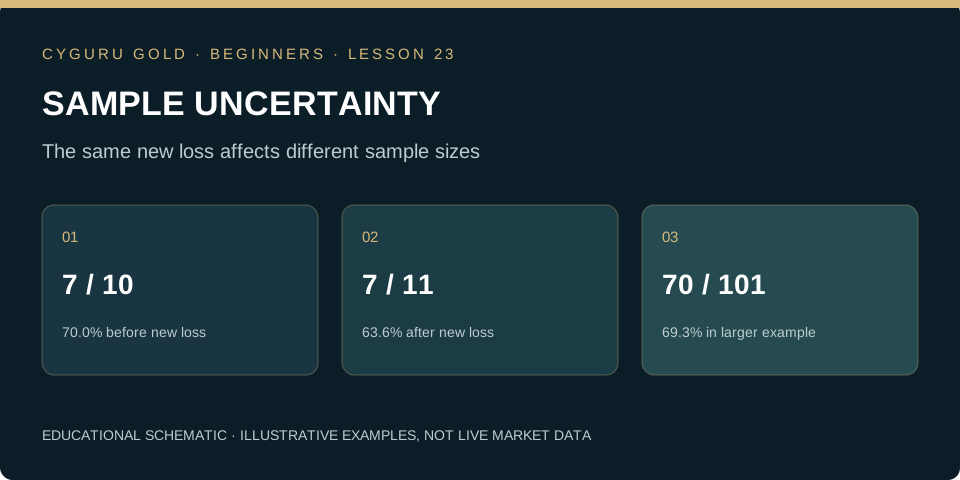
Seven wins out of ten is 70%. One additional loss makes it seven out of eleven, approximately 63.6%. With seventy wins out of one hundred, one additional loss produces seventy out of one hundred and one, approximately 69.3%. These examples illustrate sensitivity, not a universal minimum sample requirement. A larger record can still be biased or collected under conditions that differ from the next period.
Trade counts do not guarantee independent evidence
Several positions opened around the same event may share a driver. Repeated entries during one trend can resemble each other more than entries spread across varied conditions. A count of fifty tickets therefore does not automatically represent fifty independent experiments. Record clustering by date, event, market condition and rule version. Avoid presenting a precise-looking estimate without discussing how the observations were generated and whether failures were retained.
Report a distribution as well as a headline
Win rate alone omits the magnitude of gains and losses. Average R can hide a few unusually large outcomes. Record net results, largest losses, drawdown and the effect of transaction costs alongside the method definition. Where uncertainty has not been quantified, say so. A simple descriptive review is more honest than attaching an unsupported confidence claim to a small collection of trades. Changing rules repeatedly after each result adds selection uncertainty to the limited sample.
Practice task: show the estimate moving
Create an illustrative sequence of twenty fixed outcomes and calculate the running win rate and average R after each observation. Then reorder the same outcomes and compare the paths while keeping the final totals unchanged. Note how a short early section can suggest a different story from the full record. Separate this arithmetic exercise from evidence about a live strategy. Continue with the next lesson to make uncertainty part of a repeatable review process.
Can you apply the idea?
Answer three questions, then check the explanation for every answer. You can repeat the check after reviewing the lesson.
Knowledge check: not attempted
Make this lesson part of your process.
Finish the reading and its practice task, then mark the lesson as completed.
0 of 24 lessons completed
Gold Trading Mastery
From gold market fundamentals to technical analysis, execution, quantitative research and AI. A structured 160-chapter course.
Explore the book →Continue the beginner course
What Is XAU/USD? Gold Trading Explained for Beginners →
How to Read Gold Candlestick Charts: A Beginner’s Guide →
Market, Limit and Stop Orders in Gold Trading →
Gold Trading Costs: Spread, Slippage and Financing →
Stop-Loss and Take-Profit in Gold: Beginner Essentials →
Your First Gold Trading Plan: Practise Before Going Live →
Gold Position Sizing: Calculate Exposure Before You Trade →
Gold Leverage and Margin: Understand the Difference →
Support and Resistance in Gold: Read Zones Without Guessing →
Gold and the Economic Calendar: CPI, Jobs and the Fed →
Multiple-Timeframe Gold Analysis: Context, Setup and Trigger →
Gold Trading Expectancy: Evaluate Results Beyond Win Rate →
Gold Trends and Ranges: Identify the Market Before the Setup →
Gold ATR for Beginners: Measure Movement, Not Direction →
Gold Breakouts and Failed Breaks: Define the Evidence →
Gold Trading Drawdown: Understand Losses and Recovery →
How to Backtest a Gold Trading Rule Without Hindsight →
The Gold Pre-Trade Checklist: Turn a Plan into a Decision →
Gold Liquidity and Trading Sessions: Study the Conditions →
Audit a Gold Trade: Quotes, Triggers and Actual Fills →
Multiple Gold Positions: Measure the Combined Exposure →
Partial Exits and Breakeven Stops: Follow the Arithmetic →
Your Gold Trading Review: Version the Rule Before Testing Again →
Market Desk and position-risk calculator →
Position sizing explained → · Build a trading journal →
Lesson sources and further study
CME Group: Risk Management and Your Trade Plan
Core course references
CME Group: Gold Product Overview. Investor.gov: Types of Orders explains order concepts for stocks; check the execution rules of your specific gold instrument.
CYGURU GOLD editorial · Published 28 October 2026. Educational material. Illustrative prices are not current quotes or trade recommendations.