Audit a Gold Trade: Quotes, Triggers and Actual Fills
Learn to reconcile a gold chart with the order history using quote sides, timestamps, triggers and executed quantities.
Preserve the order lifecycle
A useful execution record contains more than an entry screenshot. Preserve the submitted instruction, order identifier, requested quantity, trigger or limit conditions, modification times, fills and cancellation status. Record the platform timezone and the precision of available timestamps. An instruction may be accepted before it executes, and a partial fill can leave an unfilled remainder working. Reconstruct the sequence from the provider’s records before deciding what the chart appears to prove.
Identify the price reference
A chart may display bid, ask, last transaction or another reference. The relevant order trigger can use a different basis under the provider’s rules. Investor.gov explains that stock-order trigger standards can differ between firms; a gold instrument requires its own execution policy. Avoid transferring a rule from one venue to another. A screenshot of a single price line cannot establish every quote that existed while an order was active.
Reconcile entry, stop and charges
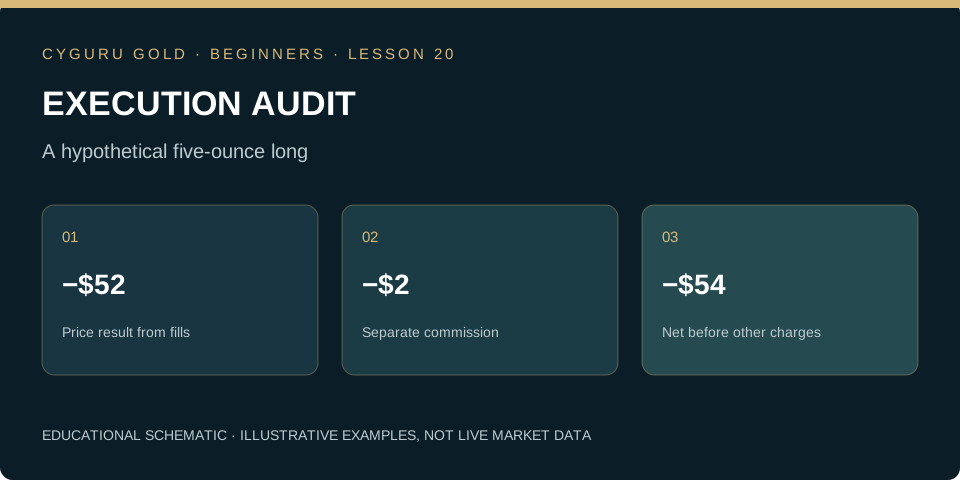
For an illustrative linear position of five ounces bought at 4,000.60 and sold at 3,990.20, the price result is 5 × -10.40 = -USD 52. If separate commissions total USD 2, the net result is -USD 54 before other adjustments. Compare the original stop trigger with the fill separately; that difference answers an execution question. Do not subtract a spread again if the recorded buying and selling fills already incorporate the relevant quote-side difference.
Describe a discrepancy before explaining it
A missed limit, an unexpected trigger and a different fill are different events. A limit boundary may preserve price control while allowing no fill. A stop-market order can trigger as planned and still execute beyond the trigger. A rejected instruction may produce no position at all. Document which event occurred, what rule applied and what evidence is missing. If contacting the provider, ask a precise question tied to the order identifier and timestamp rather than asserting a cause from one image.
Practice task: reconcile one complete example
Use a demo history or a fully documented hypothetical example. Make a timeline from submission through final closure, then calculate executed exposure, weighted entry where needed, price P/L and separately assessed fees. Mark each unavailable observation rather than inventing it. Check whether related exit orders remain active after closure under the platform’s rules. The completed audit should explain the arithmetic and identify unresolved execution details; it should not turn missing quote data into certainty.
Can you apply the idea?
Answer three questions, then check the explanation for every answer. You can repeat the check after reviewing the lesson.
Knowledge check: not attempted
Make this lesson part of your process.
Finish the reading and its practice task, then mark the lesson as completed.
0 of 24 lessons completed
The Gold Trader’s Code
100 trading rules, professional XAU/USD strategies and 50 case studies connecting analysis with risk and execution.
Explore the book →Continue the beginner course
What Is XAU/USD? Gold Trading Explained for Beginners →
How to Read Gold Candlestick Charts: A Beginner’s Guide →
Market, Limit and Stop Orders in Gold Trading →
Gold Trading Costs: Spread, Slippage and Financing →
Stop-Loss and Take-Profit in Gold: Beginner Essentials →
Your First Gold Trading Plan: Practise Before Going Live →
Gold Position Sizing: Calculate Exposure Before You Trade →
Gold Leverage and Margin: Understand the Difference →
Support and Resistance in Gold: Read Zones Without Guessing →
Gold and the Economic Calendar: CPI, Jobs and the Fed →
Multiple-Timeframe Gold Analysis: Context, Setup and Trigger →
Gold Trading Expectancy: Evaluate Results Beyond Win Rate →
Gold Trends and Ranges: Identify the Market Before the Setup →
Gold ATR for Beginners: Measure Movement, Not Direction →
Gold Breakouts and Failed Breaks: Define the Evidence →
Gold Trading Drawdown: Understand Losses and Recovery →
How to Backtest a Gold Trading Rule Without Hindsight →
The Gold Pre-Trade Checklist: Turn a Plan into a Decision →
Gold Liquidity and Trading Sessions: Study the Conditions →
Multiple Gold Positions: Measure the Combined Exposure →
Partial Exits and Breakeven Stops: Follow the Arithmetic →
Small Samples in Gold Trading: Describe the Uncertainty →
Your Gold Trading Review: Version the Rule Before Testing Again →
Market Desk and position-risk calculator →
Position sizing explained → · Build a trading journal →
Lesson sources and further study
CME Group: Risk Management and Your Trade Plan
Investor.gov: Understanding Order Types (stock-market context)
Core course references
CME Group: Gold Product Overview. Investor.gov: Types of Orders explains order concepts for stocks; check the execution rules of your specific gold instrument.
CYGURU GOLD editorial · Published 28 October 2026. Educational material. Illustrative prices are not current quotes or trade recommendations.