Gold Breakouts and Failed Breaks: Define the Evidence
Study gold breakouts with clear boundaries, timestamps and failure conditions, and distinguish an observable break from a hindsight explanation.
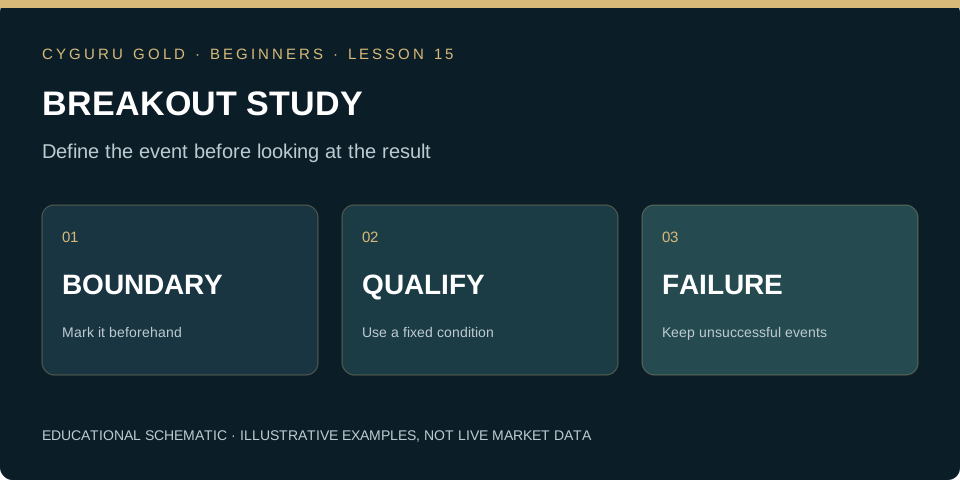
Begin with a boundary that already existed
A breakout description requires a previously defined reference. If a boundary is drawn only after seeing a large move, the apparent signal benefits from hindsight. Use the support-and-resistance process from lesson nine to mark an area before examining the subsequent candles. Record whether the boundary comes from a session range, a prior swing or another explicit method. Different definitions produce different samples. A break of a very short range should not silently be treated as equivalent to a break of a much broader structure.
Specify which event qualifies
A brief trade beyond an area, a candle close outside it and a later retest are separate observations. Choose which observation qualifies the setup before reviewing results. For example, a study rule might require a completed hourly close above a marked upper boundary. That event becomes known at the close, not at the first intrahour excursion. Requiring a retest adds another condition and may exclude moves that continue without returning. These trade-offs can be measured; the words confirmed and strong should not replace a rule that identifies the actual event.
Write failure in observable terms
A failed-break study needs a definition too. One possible research convention is a close back inside the original range within a preselected number of bars. It is not a universal market law. The observation window and price reference must be fixed before counting examples. A return inside does not reveal who placed orders, prove deliberate manipulation or establish the next direction. Preserve neutral descriptions: outside close, return inside, continuation or unresolved. Such language makes later comparisons more useful than attaching motives to candles.
Separate a valid signal from an acceptable entry
A rule may qualify while the available execution price no longer fits the original plan. Suppose a hypothetical intended entry is $2,010, invalidation is $2,000 and a study target is $2,030. The planned distances are $10 adverse and $20 favorable. Entering at $2,020 with the same references changes them to $20 adverse and $10 favorable. It is a different proposal. The example does not recommend a trade; it shows why chasing cannot be justified merely by repeating the name of the original setup.
Practice task: retain the missed moves
Review a fixed historical interval and log every event that satisfies the chosen breakout definition. Include failures, missed entries, events without a retest and ambiguous intrabar sequences. Record the earliest time the condition could have been known and the price assumption used afterward. If the method requires a fill that the chart cannot verify, label the result uncertain rather than awarding the best price. Compare the record with lesson twelve’s expectancy framework. The Gold Trader’s Code provides further reading on rules and execution; a collection of attractive breakout screenshots is not a performance record.
Can you apply the idea?
Answer three questions, then check the explanation for every answer. You can repeat the check after reviewing the lesson.
Knowledge check: not attempted
Make this lesson part of your process.
Finish the reading and its practice task, then mark the lesson as completed.
0 of 24 lessons completed
The Gold Trader’s Code
100 trading rules, professional XAU/USD strategies and 50 case studies connecting analysis with risk and execution.
Explore the book →Continue the beginner course
What Is XAU/USD? Gold Trading Explained for Beginners →
How to Read Gold Candlestick Charts: A Beginner’s Guide →
Market, Limit and Stop Orders in Gold Trading →
Gold Trading Costs: Spread, Slippage and Financing →
Stop-Loss and Take-Profit in Gold: Beginner Essentials →
Your First Gold Trading Plan: Practise Before Going Live →
Gold Position Sizing: Calculate Exposure Before You Trade →
Gold Leverage and Margin: Understand the Difference →
Support and Resistance in Gold: Read Zones Without Guessing →
Gold and the Economic Calendar: CPI, Jobs and the Fed →
Multiple-Timeframe Gold Analysis: Context, Setup and Trigger →
Gold Trading Expectancy: Evaluate Results Beyond Win Rate →
Gold Trends and Ranges: Identify the Market Before the Setup →
Gold ATR for Beginners: Measure Movement, Not Direction →
Gold Trading Drawdown: Understand Losses and Recovery →
How to Backtest a Gold Trading Rule Without Hindsight →
The Gold Pre-Trade Checklist: Turn a Plan into a Decision →
Gold Liquidity and Trading Sessions: Study the Conditions →
Audit a Gold Trade: Quotes, Triggers and Actual Fills →
Multiple Gold Positions: Measure the Combined Exposure →
Partial Exits and Breakeven Stops: Follow the Arithmetic →
Small Samples in Gold Trading: Describe the Uncertainty →
Your Gold Trading Review: Version the Rule Before Testing Again →
Market Desk and position-risk calculator →
Position sizing explained → · Build a trading journal →
Lesson sources and further study
CME Group: Position and Risk Management
Core course references
CME Group: Gold Product Overview. Investor.gov: Types of Orders explains order concepts for stocks; check the execution rules of your specific gold instrument.
CYGURU GOLD editorial · Published 27 October 2026. Educational material. Illustrative prices are not current quotes or trade recommendations.