Gold Trading Expectancy: Evaluate Results Beyond Win Rate
Calculate expectancy in risk units, separate planned targets from realized outcomes and build a beginner review that includes costs and rule adherence.
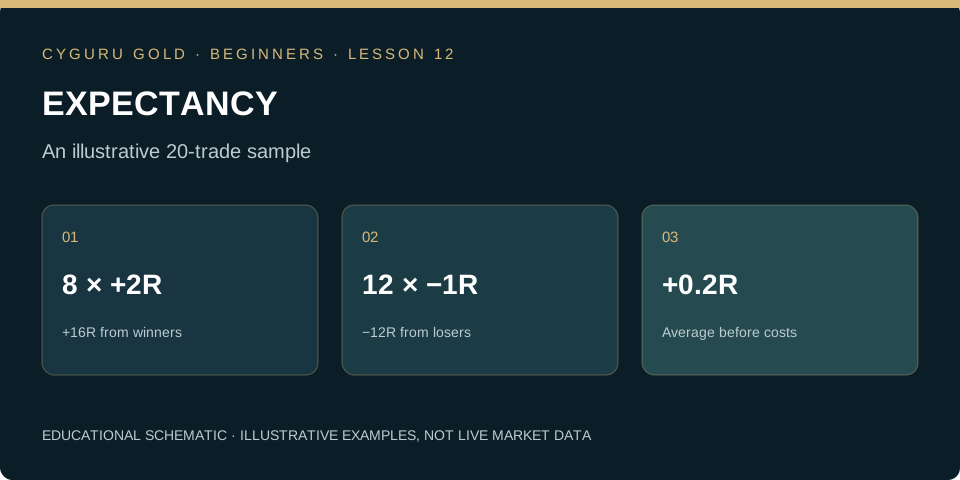
A win rate leaves half the question unanswered
Winning frequently does not establish that a method earns money. The average size of wins and losses matters, along with transaction costs and how the observations were selected. A method can win often while occasional larger losses erase the gains. Conversely, a method with fewer winners may have a positive average if realized wins are sufficiently larger. The word realized is essential: a target drawn on a chart is not a completed outcome. Evaluate what the process actually produced, including partial exits and early closures.
Define a consistent unit of risk
An R multiple expresses an outcome relative to a stated initial planned risk. If that risk was $50 and the net outcome was a $75 gain, the result is +1.5R. A $60 net loss would be −1.2R. Outcomes can exceed the planned loss because of execution differences or rule changes. Keep the denominator fixed at the original value rather than redefining it after the trade. Record currency results as well: equal R outcomes can correspond to different amounts of money when risk budgets change.
Calculate a hypothetical average
Imagine 20 completed practice trades, all with the same initial risk unit. Eight finish at +2R and twelve at −1R before separate costs. The total is 16R minus 12R, or +4R, producing a sample average of +0.2R per trade. If separate costs average 0.1R per trade, the net sample average becomes +0.1R. Do not subtract costs again if the outcomes already include them. This is arithmetic for an invented sample, not a performance claim. A small positive sample does not establish a reliable future edge.
Check the sample before trusting the average
Results depend on which trades entered the record. Excluding missed signals, inconvenient losses or periods with poor execution can bias the review. Repeatedly changing parameters until the historical chart looks attractive creates another problem: the final rule has been selected using the same outcomes offered as evidence. Keep a separate period for evaluation and document the rule version before testing. Trades clustered in one market condition may provide less variety than their count suggests. No universal sample size converts an unrepresentative record into reliable proof.
Practice task: review decisions and outcomes separately
Build a table containing the original rule version, planned entry and exit, initial risk, actual fills, fees, net result and whether the rules were followed. Calculate both the currency total and the average R multiple. Then review compliant trades separately from violations, including violations that happened to win. Describe uncertainty rather than announcing a validated strategy after a short streak. The next study cycle should change one clearly identified assumption at a time. Before You Click supports the behavioral review, while The Gold Trader’s Code extends the work on repeatable execution rules.
Can you apply the idea?
Answer three questions, then check the explanation for every answer. You can repeat the check after reviewing the lesson.
Knowledge check: not attempted
Make this lesson part of your process.
Finish the reading and its practice task, then mark the lesson as completed.
0 of 24 lessons completed
Before You Click
A practical guide to FOMO, revenge trading, stop interference and the moment before you place an order.
Explore the book →Continue the beginner course
What Is XAU/USD? Gold Trading Explained for Beginners →
How to Read Gold Candlestick Charts: A Beginner’s Guide →
Market, Limit and Stop Orders in Gold Trading →
Gold Trading Costs: Spread, Slippage and Financing →
Stop-Loss and Take-Profit in Gold: Beginner Essentials →
Your First Gold Trading Plan: Practise Before Going Live →
Gold Position Sizing: Calculate Exposure Before You Trade →
Gold Leverage and Margin: Understand the Difference →
Support and Resistance in Gold: Read Zones Without Guessing →
Gold and the Economic Calendar: CPI, Jobs and the Fed →
Multiple-Timeframe Gold Analysis: Context, Setup and Trigger →
Gold Trends and Ranges: Identify the Market Before the Setup →
Gold ATR for Beginners: Measure Movement, Not Direction →
Gold Breakouts and Failed Breaks: Define the Evidence →
Gold Trading Drawdown: Understand Losses and Recovery →
How to Backtest a Gold Trading Rule Without Hindsight →
The Gold Pre-Trade Checklist: Turn a Plan into a Decision →
Gold Liquidity and Trading Sessions: Study the Conditions →
Audit a Gold Trade: Quotes, Triggers and Actual Fills →
Multiple Gold Positions: Measure the Combined Exposure →
Partial Exits and Breakeven Stops: Follow the Arithmetic →
Small Samples in Gold Trading: Describe the Uncertainty →
Your Gold Trading Review: Version the Rule Before Testing Again →
Market Desk and position-risk calculator →
Position sizing explained → · Build a trading journal →
Lesson sources and further study
CME Group: Risk Management and Your Trade Plan
Core course references
CME Group: Gold Product Overview. Investor.gov: Types of Orders explains order concepts for stocks; check the execution rules of your specific gold instrument.
CYGURU GOLD editorial · Published 27 October 2026. Educational material. Illustrative prices are not current quotes or trade recommendations.