Your Gold Trading Review: Version the Rule Before Testing Again
Build a weekly review that separates execution problems, rule violations and method changes, with a documented forward-testing cycle.
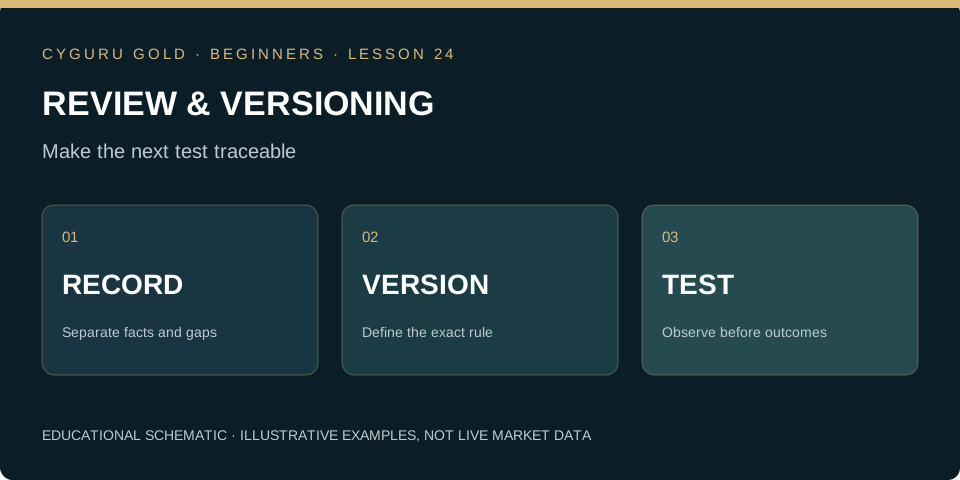
Review different questions separately
A useful weekly review asks whether orders followed the plan, whether execution matched its assumptions and what the comparable outcomes show. These questions can have different answers. A compliant trade can lose; a violation can win; a reasonable entry can receive an unexpectedly poor fill. Combining every disappointment into one verdict makes the next change difficult to justify. Start with complete records and identify which question each observation actually addresses.
Keep a stable rule version
Write the instrument, observation windows, setup conditions, invalidation, size calculation and permitted management changes in one dated version. A modification should produce a new version and a stated reason. Preserve earlier records under the version that generated them. Otherwise a collection of trades can quietly become a mixture of different methods while retaining one convenient performance headline. Versioning makes the evidence traceable; it cannot make the method profitable by itself.
Select one change for an explicit reason
Suppose the log repeatedly shows costs larger than the assumptions used in sizing. A justified next task might be to improve cost measurement or revise that assumption. It does not automatically justify changing the entry pattern, target and session together. State the observation, proposed explanation and what future record would challenge that explanation. Avoid using a short losing streak as an unrestricted license to optimize every parameter against the same historical sample.
Forward testing means preserving the decision time
In a forward practice test, document eligible observations as they occur rather than selecting them after their results are known. Record missed opportunities and reasons for no trade. Demo environments can help with this process but may differ from live fills and emotional consequences. Define when the review will occur and which events justify an earlier pause. A review boundary is a procedure for evaluating evidence, not a target number of trades that must be forced into existence.
Practice task: prepare the next study cycle
Write a one-page review containing the current rule version, sample period, net outcomes, execution discrepancies, adherence findings and remaining uncertainty. Choose either to keep studying the same version, pause while resolving an operational issue, or test one documented change. Link the decision to the evidence available now. Return to the earlier lessons when a unit, order rule or calculation remains unclear. Completing this course establishes a study foundation; repeatable live performance requires separate evidence and sustained execution.
Can you apply the idea?
Answer three questions, then check the explanation for every answer. You can repeat the check after reviewing the lesson.
Knowledge check: not attempted
Make this lesson part of your process.
Finish the reading and its practice task, then mark the lesson as completed.
0 of 24 lessons completed
Before You Click
A practical guide to FOMO, revenge trading, stop interference and the moment before you place an order.
Explore the book →Continue the beginner course
What Is XAU/USD? Gold Trading Explained for Beginners →
How to Read Gold Candlestick Charts: A Beginner’s Guide →
Market, Limit and Stop Orders in Gold Trading →
Gold Trading Costs: Spread, Slippage and Financing →
Stop-Loss and Take-Profit in Gold: Beginner Essentials →
Your First Gold Trading Plan: Practise Before Going Live →
Gold Position Sizing: Calculate Exposure Before You Trade →
Gold Leverage and Margin: Understand the Difference →
Support and Resistance in Gold: Read Zones Without Guessing →
Gold and the Economic Calendar: CPI, Jobs and the Fed →
Multiple-Timeframe Gold Analysis: Context, Setup and Trigger →
Gold Trading Expectancy: Evaluate Results Beyond Win Rate →
Gold Trends and Ranges: Identify the Market Before the Setup →
Gold ATR for Beginners: Measure Movement, Not Direction →
Gold Breakouts and Failed Breaks: Define the Evidence →
Gold Trading Drawdown: Understand Losses and Recovery →
How to Backtest a Gold Trading Rule Without Hindsight →
The Gold Pre-Trade Checklist: Turn a Plan into a Decision →
Gold Liquidity and Trading Sessions: Study the Conditions →
Audit a Gold Trade: Quotes, Triggers and Actual Fills →
Multiple Gold Positions: Measure the Combined Exposure →
Partial Exits and Breakeven Stops: Follow the Arithmetic →
Small Samples in Gold Trading: Describe the Uncertainty →
Market Desk and position-risk calculator →
Position sizing explained → · Build a trading journal →
Lesson sources and further study
CME Group: Risk Management and Your Trade Plan
Core course references
CME Group: Gold Product Overview. Investor.gov: Types of Orders explains order concepts for stocks; check the execution rules of your specific gold instrument.
CYGURU GOLD editorial · Published 28 October 2026. Educational material. Illustrative prices are not current quotes or trade recommendations.