Partial Exits and Breakeven Stops: Follow the Arithmetic
Calculate a gold position with partial exits and distinguish a stop at entry from a cost-free or guaranteed breakeven outcome.
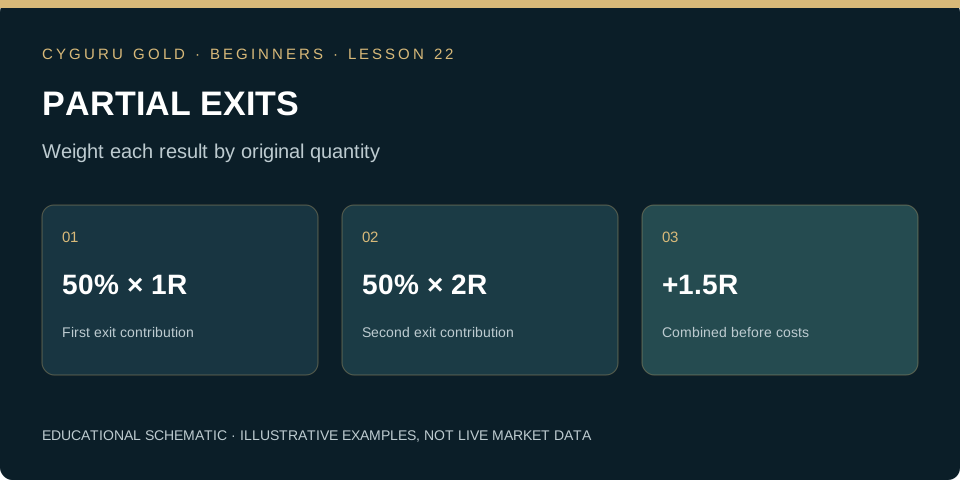
An exit fraction changes the remaining position
A partial exit closes part of the original quantity. The rest continues to carry exposure under its active instructions. Record the executed fraction and price rather than assuming that submitting a partial-close request completed it. Broker minimums and size increments may restrict which fractions are available. A plan that proposes closing half of a minimum-sized position may not be operationally possible under the instrument’s specification.
Use the original risk base consistently
Consider an illustrative ten-ounce long entered at 4,000 with a stop at 3,990. Initial price risk is USD 100 before costs. Closing five ounces at 4,010 produces USD 50. If the other five ounces close at 4,020, they produce another USD 100, for USD 150 total or +1.5R against the original USD 100 base. Adding +1R and +2R without weighting their quantities would incorrectly report +3R.
A stop at entry does not remove every cost
If the remaining five ounces instead close exactly at the entry price, their price P/L is zero while the first exit still contributes USD 50. The combined result is +0.5R before costs. Separately assessed commission, financing and execution differences can change the net amount. A stop trigger placed at entry also does not guarantee an entry-price fill. Describe the intended rule precisely rather than treating the word breakeven as a complete accounting statement.
Management rules belong in the method
Partial exits and stop adjustments change the outcome distribution of a strategy. They can affect average wins, losses, time in the market and transaction charges. Whether they improve a method is an empirical question requiring comparable observations. Define the adjustment condition before entry and preserve the original version during a test. Moving an exit after every uncomfortable candle creates a different process from a rule that changes it only after a specified observation.
Practice task: compare three exit paths
Use the same hypothetical entry, original size and initial stop for three paths: all quantity reaches the target, half exits early and the rest reaches the target, or half exits early and the remainder closes at entry. Calculate currency P/L first, then divide by the same initial risk base. Apply explicit costs afterward using the correct charging structure. This comparison explains the consequences of the rules; it does not tell you which rule will perform best in future markets.
Can you apply the idea?
Answer three questions, then check the explanation for every answer. You can repeat the check after reviewing the lesson.
Knowledge check: not attempted
Make this lesson part of your process.
Finish the reading and its practice task, then mark the lesson as completed.
0 of 24 lessons completed
The Gold Trader’s Code
100 trading rules, professional XAU/USD strategies and 50 case studies connecting analysis with risk and execution.
Explore the book →Continue the beginner course
What Is XAU/USD? Gold Trading Explained for Beginners →
How to Read Gold Candlestick Charts: A Beginner’s Guide →
Market, Limit and Stop Orders in Gold Trading →
Gold Trading Costs: Spread, Slippage and Financing →
Stop-Loss and Take-Profit in Gold: Beginner Essentials →
Your First Gold Trading Plan: Practise Before Going Live →
Gold Position Sizing: Calculate Exposure Before You Trade →
Gold Leverage and Margin: Understand the Difference →
Support and Resistance in Gold: Read Zones Without Guessing →
Gold and the Economic Calendar: CPI, Jobs and the Fed →
Multiple-Timeframe Gold Analysis: Context, Setup and Trigger →
Gold Trading Expectancy: Evaluate Results Beyond Win Rate →
Gold Trends and Ranges: Identify the Market Before the Setup →
Gold ATR for Beginners: Measure Movement, Not Direction →
Gold Breakouts and Failed Breaks: Define the Evidence →
Gold Trading Drawdown: Understand Losses and Recovery →
How to Backtest a Gold Trading Rule Without Hindsight →
The Gold Pre-Trade Checklist: Turn a Plan into a Decision →
Gold Liquidity and Trading Sessions: Study the Conditions →
Audit a Gold Trade: Quotes, Triggers and Actual Fills →
Multiple Gold Positions: Measure the Combined Exposure →
Small Samples in Gold Trading: Describe the Uncertainty →
Your Gold Trading Review: Version the Rule Before Testing Again →
Market Desk and position-risk calculator →
Position sizing explained → · Build a trading journal →
Lesson sources and further study
CME Group: Risk Management and Your Trade Plan
Core course references
CME Group: Gold Product Overview. Investor.gov: Types of Orders explains order concepts for stocks; check the execution rules of your specific gold instrument.
CYGURU GOLD editorial · Published 28 October 2026. Educational material. Illustrative prices are not current quotes or trade recommendations.