Gold and the Economic Calendar: CPI, Jobs and the Fed
Build an economic-event checklist for gold, distinguish actual data from expectations and revisions, and handle release times without timezone mistakes.
The calendar identifies uncertainty windows
Economic calendars help identify scheduled information releases; they do not provide a ready-made buy or sell instruction. Inflation, employment and central-bank communication can change expectations about economic conditions and interest rates. Gold’s response depends on context, positioning and competing influences. A useful beginner routine records the event, source, release time and whether the practice method permits trading around it. When that environment has not been studied, observing rather than improvising is a coherent rule. Unscheduled headlines remain possible even on a quiet calendar.
Read actual, expected and previous carefully
The actual value is the newly published observation. A consensus forecast, when displayed, usually comes from a survey or data provider and is not the same as an official target. The previous figure may also be revised. A headline that appears stronger than expected can coexist with weaker revisions or a different message in another component. Record which measure is being compared: a monthly change is not an annual change, and a level is not a growth rate. Read the release before building a story around a colored surprise indicator.
Separate the decision from the interpretation
A central-bank rate decision, the wording of its statement and a subsequent press conference are distinct pieces of information. The initial reaction can change as the market interprets later details. Similarly, an employment report contains more than a single payroll number. Do not reduce this process to a rule that good data always means lower gold or weak data always means higher gold. The Chicago Fed’s research discusses several gold-price drivers and illustrates why relationships require context. A historical association is not an intraday execution signal.
Verify the clock at the source
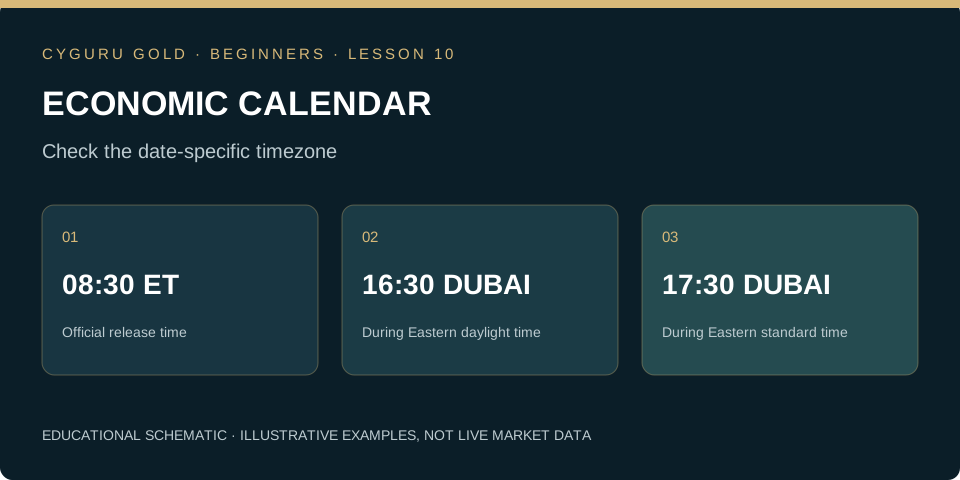
The BLS schedule states that its times are Eastern Time. Eastern Time changes its UTC offset seasonally, whereas Dubai stays at UTC+4. An event scheduled at 08:30 Eastern therefore corresponds to 16:30 Dubai during Eastern daylight time or 17:30 during Eastern standard time. Confirm the date-specific conversion instead of reusing yesterday’s offset. Cross-check Federal Reserve events against the official calendar. Use the provider’s execution documentation to understand trading availability; a calendar entry does not promise normal spreads, uninterrupted fills or a specific price reaction.
Practice task: observe one release without an order
Choose a scheduled event and save the official source link before publication. Record the expected measure, actual release, revisions and chart timestamps. Compare conditions immediately before and after the release, including executable spread if available. Distinguish what was known beforehand from explanations discovered afterward. End with a process conclusion: was the event correctly identified, was the time correct, and did the observation-only rule hold? Link this record to the trading plan from lesson six. The objective is event literacy before attempting any event-driven method.
Can you apply the idea?
Answer three questions, then check the explanation for every answer. You can repeat the check after reviewing the lesson.
Knowledge check: not attempted
Make this lesson part of your process.
Finish the reading and its practice task, then mark the lesson as completed.
0 of 24 lessons completed
Gold Trading Mastery
From gold market fundamentals to technical analysis, execution, quantitative research and AI. A structured 160-chapter course.
Explore the book →Continue the beginner course
What Is XAU/USD? Gold Trading Explained for Beginners →
How to Read Gold Candlestick Charts: A Beginner’s Guide →
Market, Limit and Stop Orders in Gold Trading →
Gold Trading Costs: Spread, Slippage and Financing →
Stop-Loss and Take-Profit in Gold: Beginner Essentials →
Your First Gold Trading Plan: Practise Before Going Live →
Gold Position Sizing: Calculate Exposure Before You Trade →
Gold Leverage and Margin: Understand the Difference →
Support and Resistance in Gold: Read Zones Without Guessing →
Multiple-Timeframe Gold Analysis: Context, Setup and Trigger →
Gold Trading Expectancy: Evaluate Results Beyond Win Rate →
Gold Trends and Ranges: Identify the Market Before the Setup →
Gold ATR for Beginners: Measure Movement, Not Direction →
Gold Breakouts and Failed Breaks: Define the Evidence →
Gold Trading Drawdown: Understand Losses and Recovery →
How to Backtest a Gold Trading Rule Without Hindsight →
The Gold Pre-Trade Checklist: Turn a Plan into a Decision →
Gold Liquidity and Trading Sessions: Study the Conditions →
Audit a Gold Trade: Quotes, Triggers and Actual Fills →
Multiple Gold Positions: Measure the Combined Exposure →
Partial Exits and Breakeven Stops: Follow the Arithmetic →
Small Samples in Gold Trading: Describe the Uncertainty →
Your Gold Trading Review: Version the Rule Before Testing Again →
Market Desk and position-risk calculator →
Position sizing explained → · Build a trading journal →
Lesson sources and further study
BLS: Official release schedule (Eastern Time)
Federal Reserve: FOMC calendars
Chicago Fed: What Drives Gold Prices?
Core course references
CME Group: Gold Product Overview. Investor.gov: Types of Orders explains order concepts for stocks; check the execution rules of your specific gold instrument.
CYGURU GOLD editorial · Published 27 October 2026. Educational material. Illustrative prices are not current quotes or trade recommendations.