Gold Leverage and Margin: Understand the Difference
Separate gold exposure, margin and account risk with a clear numerical example, and learn why available buying power is not a trading budget.
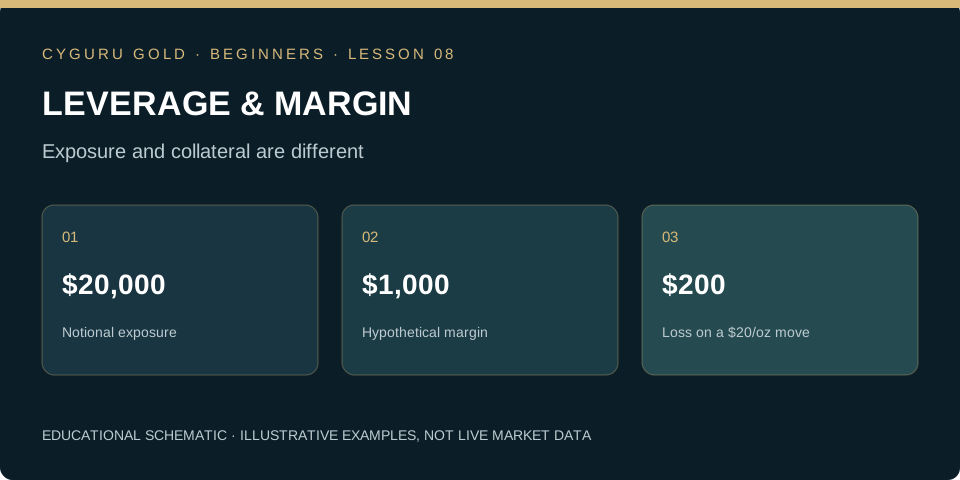
Three numbers that should never be confused
Exposure is the amount of market value controlled. Margin is collateral required under the relevant product rules. Account risk concerns the losses that changes in price and execution can create. A small collateral requirement can coexist with large exposure. Confusing collateral with risk encourages traders to judge a position by how affordable it looks to open rather than by what an adverse move would do. The definitions and calculations must come from the actual instrument; securities borrowing, futures performance bonds and broker derivatives are not identical arrangements.
A hypothetical exposure example
Suppose a linear gold position represents ten ounces at an illustrative $2,000 per ounce. Its notional value is $20,000. If a hypothetical provider requires collateral equal to five percent of that value, the initial requirement would be $1,000. A $20 adverse price move per ounce would produce approximately $200 of price loss before costs, regardless of the $1,000 collateral figure. Against $2,000 of account equity, that is ten percent. The collateral percentage in this example is an arithmetic assumption, not an available offer or a statement of applicable regulation.
Buying power is a limit, not a target
A platform may permit a position larger than the trader’s planned risk would justify. Using all available capacity reduces flexibility when prices move, collateral requirements change or other positions lose value. Begin with the exit scenario and exposure calculation from lesson seven. Only then check the collateral requirement. Reversing that order turns the broker’s maximum into the trader’s default. A position does not become suitable because an order ticket accepts it, and a large unused balance does not make an untested method reliable.
Liquidation and stop orders serve different purposes
A provider’s margin closeout process follows its contract and operating rules. It is not a substitute for the trader’s planned exit. Read when collateral is recalculated, how warnings are delivered, which positions may be closed and what charges apply. Do not assume a warning guarantees time to act. Likewise, a normal stop can execute beyond its trigger, while a stop-limit may remain unfilled. Whether a deficit can exceed deposited funds depends on the instrument, agreement and applicable protections. Verify those terms instead of importing assumptions from another account.
Practice task: explain the account statement
On a demo statement, identify equity, open profit or loss, used margin, available margin and total position quantity. Reconcile the numbers using the platform’s documentation. Then calculate the effect of a hypothetical adverse move without adding any new position. Keep this exercise separate from predicting gold’s direction. Investor.gov’s leveraged-investing bulletin explains general leverage risks in securities; use the actual gold provider’s disclosure for product-specific rules. Gold Trading Mastery offers the wider study path from instrument selection to execution and risk.
Can you apply the idea?
Answer three questions, then check the explanation for every answer. You can repeat the check after reviewing the lesson.
Knowledge check: not attempted
Make this lesson part of your process.
Finish the reading and its practice task, then mark the lesson as completed.
0 of 24 lessons completed
Gold Trading Mastery
From gold market fundamentals to technical analysis, execution, quantitative research and AI. A structured 160-chapter course.
Explore the book →Continue the beginner course
What Is XAU/USD? Gold Trading Explained for Beginners →
How to Read Gold Candlestick Charts: A Beginner’s Guide →
Market, Limit and Stop Orders in Gold Trading →
Gold Trading Costs: Spread, Slippage and Financing →
Stop-Loss and Take-Profit in Gold: Beginner Essentials →
Your First Gold Trading Plan: Practise Before Going Live →
Gold Position Sizing: Calculate Exposure Before You Trade →
Support and Resistance in Gold: Read Zones Without Guessing →
Gold and the Economic Calendar: CPI, Jobs and the Fed →
Multiple-Timeframe Gold Analysis: Context, Setup and Trigger →
Gold Trading Expectancy: Evaluate Results Beyond Win Rate →
Gold Trends and Ranges: Identify the Market Before the Setup →
Gold ATR for Beginners: Measure Movement, Not Direction →
Gold Breakouts and Failed Breaks: Define the Evidence →
Gold Trading Drawdown: Understand Losses and Recovery →
How to Backtest a Gold Trading Rule Without Hindsight →
The Gold Pre-Trade Checklist: Turn a Plan into a Decision →
Gold Liquidity and Trading Sessions: Study the Conditions →
Audit a Gold Trade: Quotes, Triggers and Actual Fills →
Multiple Gold Positions: Measure the Combined Exposure →
Partial Exits and Breakeven Stops: Follow the Arithmetic →
Small Samples in Gold Trading: Describe the Uncertainty →
Your Gold Trading Review: Version the Rule Before Testing Again →
Market Desk and position-risk calculator →
Position sizing explained → · Build a trading journal →
Lesson sources and further study
Investor.gov: Leveraged Investing Strategies (securities context)
Core course references
CME Group: Gold Product Overview. Investor.gov: Types of Orders explains order concepts for stocks; check the execution rules of your specific gold instrument.
CYGURU GOLD editorial · Published 27 October 2026. Educational material. Illustrative prices are not current quotes or trade recommendations.