Multiple Gold Positions: Measure the Combined Exposure
Evaluate overlapping gold positions with an aggregate budget and a stated stress scenario rather than counting tickets as diversification.
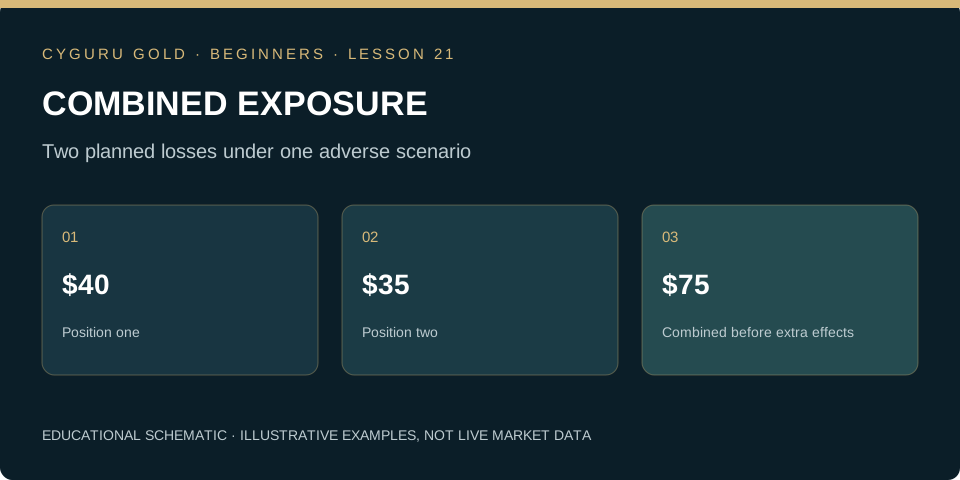
Count exposure, not tickets
Three order tickets on the same underlying can represent one concentrated directional idea. Splitting a position into smaller entries does not automatically diversify its risk. Start by listing the underlying exposure, direction, quantity and adverse conditions for every open position. Include pending orders that could create additional exposure. A trade-by-trade budget becomes incomplete when each new order is assessed as though the existing account positions did not exist.
Add planned losses under a stated scenario
Suppose two hypothetical long gold positions imply USD 40 and USD 35 of loss at their respective planned stops. Their combined planned stop loss is USD 75 under those execution assumptions. That is arithmetic, not a guaranteed account-loss limit: gaps, costs and differing trigger behavior can alter outcomes. Write the assumed adverse path explicitly. If the plan also limits session loss, distinguish losses already realized from exposure that remains open.
Map shared drivers without assuming fixed correlations
Gold, another metal and a currency position can respond to some of the same market developments. Their relationship need not remain constant across conditions or observation windows. A simple beginner review can list the hypothesized shared driver and ask what happens if several positions move adversely together. This scenario map is more informative than declaring that different symbols must be independent. It still does not capture every possible source of account risk.
Do not confuse offsetting labels with eliminated risk
A long and a short can reduce net directional exposure while leaving gross positions, spread costs, financing effects and operational obligations. Different contracts or maturities can also leave basis risk. The platform’s netting or hedging treatment matters. Before describing a combination as protected, state which quantity is offset, what can still vary and how exits interact. A smaller net number is not sufficient evidence that every relevant risk has disappeared.
Practice task: write an account exposure sheet
Create a sheet showing each hypothetical position and pending instruction, underlying units, direction, planned adverse distance and separate cost assumptions. Add a clearly labeled combined-stress column and compare it with a chosen aggregate practice budget. Recalculate after a partial close or new fill. Do not count a target as money already available to absorb losses. The exercise should make account-level constraints visible before another order is considered, rather than after several related losses occur.
Can you apply the idea?
Answer three questions, then check the explanation for every answer. You can repeat the check after reviewing the lesson.
Knowledge check: not attempted
Make this lesson part of your process.
Finish the reading and its practice task, then mark the lesson as completed.
0 of 24 lessons completed
The Gold Trader’s Code
100 trading rules, professional XAU/USD strategies and 50 case studies connecting analysis with risk and execution.
Explore the book →Continue the beginner course
What Is XAU/USD? Gold Trading Explained for Beginners →
How to Read Gold Candlestick Charts: A Beginner’s Guide →
Market, Limit and Stop Orders in Gold Trading →
Gold Trading Costs: Spread, Slippage and Financing →
Stop-Loss and Take-Profit in Gold: Beginner Essentials →
Your First Gold Trading Plan: Practise Before Going Live →
Gold Position Sizing: Calculate Exposure Before You Trade →
Gold Leverage and Margin: Understand the Difference →
Support and Resistance in Gold: Read Zones Without Guessing →
Gold and the Economic Calendar: CPI, Jobs and the Fed →
Multiple-Timeframe Gold Analysis: Context, Setup and Trigger →
Gold Trading Expectancy: Evaluate Results Beyond Win Rate →
Gold Trends and Ranges: Identify the Market Before the Setup →
Gold ATR for Beginners: Measure Movement, Not Direction →
Gold Breakouts and Failed Breaks: Define the Evidence →
Gold Trading Drawdown: Understand Losses and Recovery →
How to Backtest a Gold Trading Rule Without Hindsight →
The Gold Pre-Trade Checklist: Turn a Plan into a Decision →
Gold Liquidity and Trading Sessions: Study the Conditions →
Audit a Gold Trade: Quotes, Triggers and Actual Fills →
Partial Exits and Breakeven Stops: Follow the Arithmetic →
Small Samples in Gold Trading: Describe the Uncertainty →
Your Gold Trading Review: Version the Rule Before Testing Again →
Market Desk and position-risk calculator →
Position sizing explained → · Build a trading journal →
Lesson sources and further study
CME Group: Risk Management and Your Trade Plan
Core course references
CME Group: Gold Product Overview. Investor.gov: Types of Orders explains order concepts for stocks; check the execution rules of your specific gold instrument.
CYGURU GOLD editorial · Published 28 October 2026. Educational material. Illustrative prices are not current quotes or trade recommendations.