Gold Trends and Ranges: Identify the Market Before the Setup
Learn to distinguish trends, ranges and uncertain transitions in gold, using explicit observations rather than hindsight or a single candle.
The same pattern can ask different questions
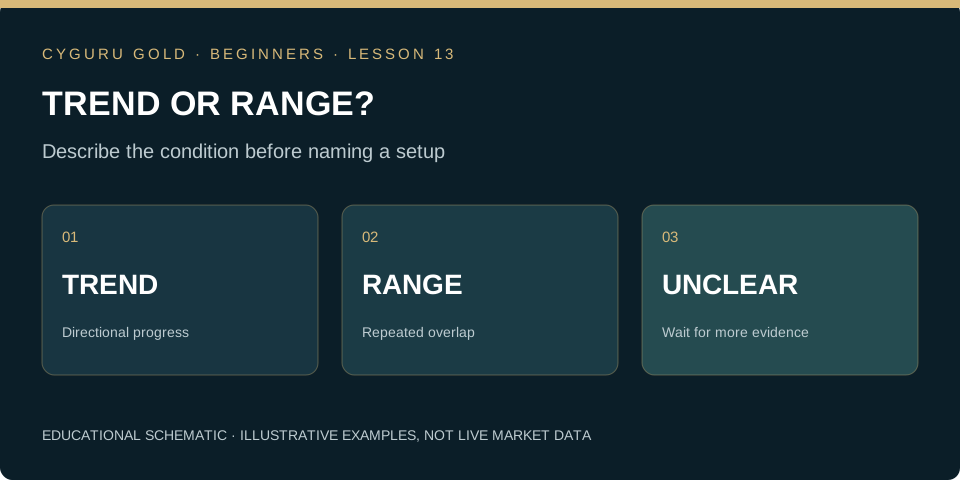
A pullback inside an orderly advance and a decline inside an overlapping range may look similar on a small chart. Their surrounding conditions differ. Before naming an entry pattern, describe the market in which it appears. A trend describes directional progress over a chosen interval; a range describes repeated trading within an area without sustained progress in either direction. These are working descriptions, not permanent identities. The observation window belongs in the description because a market can trend on one timeframe while ranging on another.
Define what counts as a swing
One practical study convention describes an advance through successive higher swing highs and higher swing lows. But a swing must itself have a definition. If you require bars on both sides of a turning point, the turning point becomes confirmed only after those later bars exist. Mark when confirmation occurred rather than treating the final pattern as immediately visible. Choose a simple convention and keep it consistent during the exercise. Changing the meaning of a swing whenever an interpretation becomes uncomfortable makes the classification impossible to evaluate.
Recognize overlap without forcing a direction
In a range, price may revisit the same areas repeatedly. Mark the observed boundaries using the zone process from lesson nine and record the width in price units. A narrow-looking range on a compressed chart may still represent substantial monetary exposure at a large quantity. The middle of a range can offer less clearly defined reference points than its edges, but location alone does not establish an advantage. Avoid assuming that repeated contact makes a boundary unbreakable. Range persistence is a hypothesis that can fail.
Allow an uncertain category
A strong directional candle can occur inside a range, and a trend can pause without immediately reversing. Instead of assigning every chart to bullish or bearish, include a transition or unclear category. State what additional observation would change that classification. This prevents a forced forecast from becoming a trading obligation. A method designed for one condition does not automatically apply to another. If a practice plan requires an orderly trend and the observations no longer meet that definition, the plan can withhold permission even when an attractive-looking candle appears.
Practice task: classify before revealing the next section
Select ten chart windows without viewing their later outcomes. Use the same timeframe, swing definition and observation length for every window. Label each trend, range or unclear and write two observable reasons. Reveal the next section and note how often the initial condition persisted, changed or was too ambiguous to use. Do not erase the unclear cases or redraw swings to improve the record. This exercise trains consistent description; it does not prove a profitable strategy. Continue with lesson fourteen to separate directional structure from the size of recent price movement.
Can you apply the idea?
Answer three questions, then check the explanation for every answer. You can repeat the check after reviewing the lesson.
Knowledge check: not attempted
Make this lesson part of your process.
Finish the reading and its practice task, then mark the lesson as completed.
0 of 24 lessons completed
The Gold Trader’s Code
100 trading rules, professional XAU/USD strategies and 50 case studies connecting analysis with risk and execution.
Explore the book →Continue the beginner course
What Is XAU/USD? Gold Trading Explained for Beginners →
How to Read Gold Candlestick Charts: A Beginner’s Guide →
Market, Limit and Stop Orders in Gold Trading →
Gold Trading Costs: Spread, Slippage and Financing →
Stop-Loss and Take-Profit in Gold: Beginner Essentials →
Your First Gold Trading Plan: Practise Before Going Live →
Gold Position Sizing: Calculate Exposure Before You Trade →
Gold Leverage and Margin: Understand the Difference →
Support and Resistance in Gold: Read Zones Without Guessing →
Gold and the Economic Calendar: CPI, Jobs and the Fed →
Multiple-Timeframe Gold Analysis: Context, Setup and Trigger →
Gold Trading Expectancy: Evaluate Results Beyond Win Rate →
Gold ATR for Beginners: Measure Movement, Not Direction →
Gold Breakouts and Failed Breaks: Define the Evidence →
Gold Trading Drawdown: Understand Losses and Recovery →
How to Backtest a Gold Trading Rule Without Hindsight →
The Gold Pre-Trade Checklist: Turn a Plan into a Decision →
Gold Liquidity and Trading Sessions: Study the Conditions →
Audit a Gold Trade: Quotes, Triggers and Actual Fills →
Multiple Gold Positions: Measure the Combined Exposure →
Partial Exits and Breakeven Stops: Follow the Arithmetic →
Small Samples in Gold Trading: Describe the Uncertainty →
Your Gold Trading Review: Version the Rule Before Testing Again →
Market Desk and position-risk calculator →
Position sizing explained → · Build a trading journal →
Lesson sources and further study
CME Group: Risk Management and Your Trade Plan
Core course references
CME Group: Gold Product Overview. Investor.gov: Types of Orders explains order concepts for stocks; check the execution rules of your specific gold instrument.
CYGURU GOLD editorial · Published 27 October 2026. Educational material. Illustrative prices are not current quotes or trade recommendations.