Gold Premiums and Buyback: Calculate the Round-Trip Hurdle
Calculate a physical gold premium, repurchase deduction and illustrative breakeven move using the full purchase and sale assumptions.
Ask for both sides of the transaction
A purchase quote answers how much you pay today. A buyback quote answers how the dealer would value a sale under specified conditions. Those are different prices and may change independently. Request the exact product, fine weight, quote time, currency, payment charges and testing requirements on both sides. Distinguish an indicative repurchase explanation from a binding bid. Before comparing dealers, check that each is quoting the same product and that the condition and packaging assumptions are comparable.
Measure the premium on a consistent reference
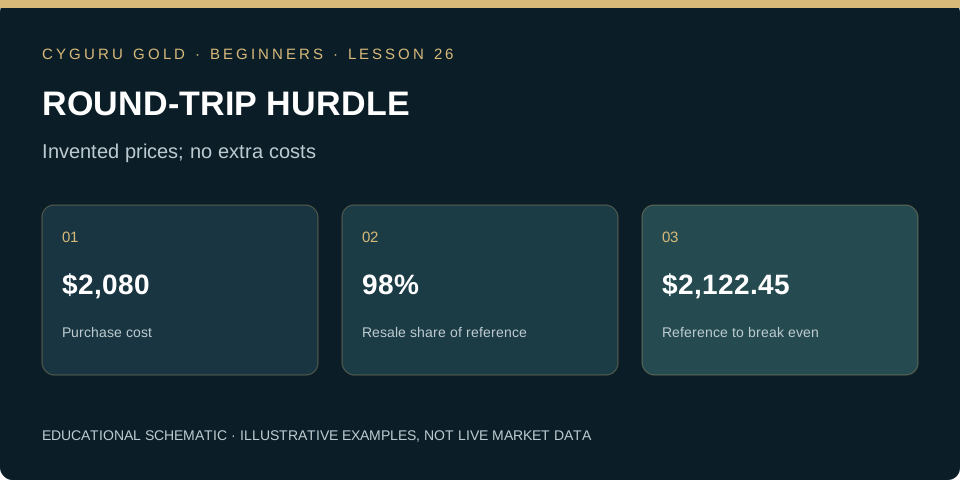
Suppose one fine ounce has an invented reference value of USD 2,000 and a product costs USD 2,080, before any additional charges. The purchase premium is USD 80, or 4% of the reference. If another product contains a different fine weight, normalize the reference first. Dividing the USD 80 by the retail price produces a different percentage because the denominator changes. State which convention you use. The quoted premium is a component of acquisition cost; it is not money that the next buyer must return.
Calculate the complete breakeven condition
Assume the resale proceeds would equal 98% of the reference price at sale, with no further charges. To recover a USD 2,080 purchase cost, the later reference must satisfy 0.98 × reference = 2,080. The required reference is approximately USD 2,122.45: about 6.12% above the initial USD 2,000. A 4% rise would not suffice under these assumptions. This is original teaching arithmetic, not a forecast, dealer tariff or universal threshold. Changing either the premium or the repurchase formula changes the answer.
Add costs according to when they occur
Storage, insurance, transfer fees, delivery and testing may apply depending on the arrangement. Separate one-time costs from recurring costs and identify the holding period. If the example adds USD 20 of total extra costs, breakeven resale proceeds must cover USD 2,100 and the reference threshold becomes USD 2,142.86 under the same 98% formula. Avoid counting a charge twice when it is already included in the acquisition quote. Tax treatment depends on the product and jurisdiction; verify it separately rather than assuming an exemption.
Practice task: vary one assumption at a time
Make a small table with purchase premiums of 2%, 4% and 6%, holding the initial reference and the resale deduction fixed. Then repeat with a different resale deduction while preserving the purchase price. Label every assumption and compare the required reference move. Explain which cost is paid upfront and which affects exit proceeds. Do not treat the cheapest purchase quote as automatically the lowest round-trip cost. Use the fine-content lesson whenever the products being compared differ in weight or purity.
Can you apply the idea?
Answer three questions, then check the explanation for every answer. You can repeat the check after reviewing the lesson.
Knowledge check: not attempted
Make this lesson part of your process.
Finish the reading and its practice task, then mark the lesson as completed.
0 of 34 lessons completed
Gold Trading Mastery
From gold market fundamentals to technical analysis, execution, quantitative research and AI. A structured 160-chapter course.
Explore the book →Continue the beginner course
What Is XAU/USD? Gold Trading Explained for Beginners →
How to Read Gold Candlestick Charts: A Beginner’s Guide →
Market, Limit and Stop Orders in Gold Trading →
Gold Trading Costs: Spread, Slippage and Financing →
Stop-Loss and Take-Profit in Gold: Beginner Essentials →
Your First Gold Trading Plan: Practise Before Going Live →
Gold Position Sizing: Calculate Exposure Before You Trade →
Gold Leverage and Margin: Understand the Difference →
Support and Resistance in Gold: Read Zones Without Guessing →
Gold and the Economic Calendar: CPI, Jobs and the Fed →
Multiple-Timeframe Gold Analysis: Context, Setup and Trigger →
Gold Trading Expectancy: Evaluate Results Beyond Win Rate →
Gold Trends and Ranges: Identify the Market Before the Setup →
Gold ATR for Beginners: Measure Movement, Not Direction →
Gold Breakouts and Failed Breaks: Define the Evidence →
Gold Trading Drawdown: Understand Losses and Recovery →
How to Backtest a Gold Trading Rule Without Hindsight →
The Gold Pre-Trade Checklist: Turn a Plan into a Decision →
Gold Liquidity and Trading Sessions: Study the Conditions →
Audit a Gold Trade: Quotes, Triggers and Actual Fills →
Multiple Gold Positions: Measure the Combined Exposure →
Partial Exits and Breakeven Stops: Follow the Arithmetic →
Small Samples in Gold Trading: Describe the Uncertainty →
Your Gold Trading Review: Version the Rule Before Testing Again →
Gold Weight and Purity: Calculate the Fine Gold Content →
Allocated and Unallocated Gold: Understand the Ownership Claim →
Gold Benchmarks and Spot Quotes: Compare Like with Like →
Gold Returns in Your Currency: Separate Metal and FX Effects →
Gold Futures Tick Value: Translate Price Moves into Money →
Gold Futures Daily Settlement: Follow the Cash Through the Account →
Gold COT Reports: Read Positioning Without Inventing a Signal →
Gold ETFs: NAV, Market Price and Tracking Difference →
Gold in a Portfolio: Calculate Weight Drift and Rebalancing →
Market Desk and position-risk calculator →
Position sizing explained → · Build a trading journal →
Lesson sources and further study
World Gold Council: Retail Gold Investment Principles
Core course references
CME Group: Gold Product Overview. Investor.gov: Types of Orders explains order concepts for stocks; check the execution rules of your specific gold instrument.
Gabriel Nicolaev — CyGuru · Published 5 November 2026. Educational material. Illustrative prices are not current quotes or trade recommendations.