Gold Weight and Purity: Calculate the Fine Gold Content
Convert grams and troy ounces, interpret fineness and karat, and calculate the fine gold content before comparing two physical products.
Start with a unit and a definition
Two objects described as gold can contain different quantities of pure metal even when they weigh the same. Gross weight includes the alloy; fine gold content measures the gold alone. Fineness expresses the gold proportion in parts per thousand, while karat describes it on a twenty-four-part scale. A label, invoice or assay should identify the claimed composition. A calculation based on that claim does not verify authenticity. Keep measurement, stated purity and independent verification as separate fields in your comparison.
Convert weight before comparing prices
One troy ounce is approximately 31.1034768 grams. The ordinary avoirdupois ounce used for many everyday goods is a different unit. If a reference is quoted in dollars per troy ounce, divide by 31.1034768 to obtain the price per gram of fine gold. Do not compare that figure directly with a price per gram of a lower-purity alloy. Use the same currency, observation time and fine-metal basis before interpreting a price difference as a premium.
Work through a purity example
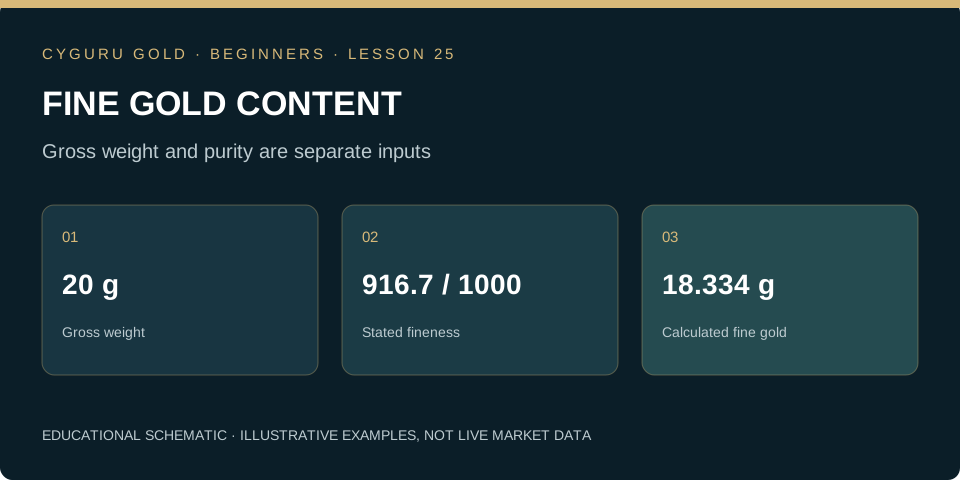
A hypothetical 20-gram item with fineness 916.7 contains 20 × 0.9167 = 18.334 grams of fine gold under the stated assumption. At an invented reference of USD 80 per fine gram, its metal reference value is USD 1,466.72. A different 20-gram item marked 999.9 contains 19.998 fine grams and has a reference value of USD 1,599.84 at the same price. Equal gross weight therefore does not mean equal fine gold content. Neither calculation includes workmanship, dealer costs or resale deductions.
Keep composition separate from the product’s sale price
Jewellery, collectible coins and investment bars can carry different non-metal components of value. A buyer may be paying for design, rarity, manufacture or distribution as well as gold. Conversely, a resale buyer may price primarily for recoverable metal and deduct testing or processing charges. Ask what the purchase quote includes and what the repurchase method excludes. A useful comparison preserves the gross weight, fineness, fine weight, full purchase price and relevant documents rather than reducing everything to a single price-per-gram label.
Practice task: compare two invoices
Prepare an imaginary comparison between a 10-gram item marked 750 and a 10-gram item marked 999.9. Their fine contents are 7.5 and 9.999 grams. At the same invented USD 80 reference, calculate USD 600 and USD 799.92 of metal reference value. Then add distinct hypothetical manufacturing charges and explain why the retail-price gap is not solely a purity gap. Record that all quantities depend on the stated fineness. Continue to the premium lesson to connect the metal calculation with a complete round trip.
Can you apply the idea?
Answer three questions, then check the explanation for every answer. You can repeat the check after reviewing the lesson.
Knowledge check: not attempted
Make this lesson part of your process.
Finish the reading and its practice task, then mark the lesson as completed.
0 of 34 lessons completed
Gold Trading Mastery
From gold market fundamentals to technical analysis, execution, quantitative research and AI. A structured 160-chapter course.
Explore the book →Continue the beginner course
What Is XAU/USD? Gold Trading Explained for Beginners →
How to Read Gold Candlestick Charts: A Beginner’s Guide →
Market, Limit and Stop Orders in Gold Trading →
Gold Trading Costs: Spread, Slippage and Financing →
Stop-Loss and Take-Profit in Gold: Beginner Essentials →
Your First Gold Trading Plan: Practise Before Going Live →
Gold Position Sizing: Calculate Exposure Before You Trade →
Gold Leverage and Margin: Understand the Difference →
Support and Resistance in Gold: Read Zones Without Guessing →
Gold and the Economic Calendar: CPI, Jobs and the Fed →
Multiple-Timeframe Gold Analysis: Context, Setup and Trigger →
Gold Trading Expectancy: Evaluate Results Beyond Win Rate →
Gold Trends and Ranges: Identify the Market Before the Setup →
Gold ATR for Beginners: Measure Movement, Not Direction →
Gold Breakouts and Failed Breaks: Define the Evidence →
Gold Trading Drawdown: Understand Losses and Recovery →
How to Backtest a Gold Trading Rule Without Hindsight →
The Gold Pre-Trade Checklist: Turn a Plan into a Decision →
Gold Liquidity and Trading Sessions: Study the Conditions →
Audit a Gold Trade: Quotes, Triggers and Actual Fills →
Multiple Gold Positions: Measure the Combined Exposure →
Partial Exits and Breakeven Stops: Follow the Arithmetic →
Small Samples in Gold Trading: Describe the Uncertainty →
Your Gold Trading Review: Version the Rule Before Testing Again →
Gold Premiums and Buyback: Calculate the Round-Trip Hurdle →
Allocated and Unallocated Gold: Understand the Ownership Claim →
Gold Benchmarks and Spot Quotes: Compare Like with Like →
Gold Returns in Your Currency: Separate Metal and FX Effects →
Gold Futures Tick Value: Translate Price Moves into Money →
Gold Futures Daily Settlement: Follow the Cash Through the Account →
Gold COT Reports: Read Positioning Without Inventing a Signal →
Gold ETFs: NAV, Market Price and Tracking Difference →
Gold in a Portfolio: Calculate Weight Drift and Rebalancing →
Market Desk and position-risk calculator →
Position sizing explained → · Build a trading journal →
Lesson sources and further study
LBMA: The Price — fine troy ounce conventions
Bank of England: Gold statistics and fine gold weight
Core course references
CME Group: Gold Product Overview. Investor.gov: Types of Orders explains order concepts for stocks; check the execution rules of your specific gold instrument.
Gabriel Nicolaev — CyGuru · Published 5 November 2026. Educational material. Illustrative prices are not current quotes or trade recommendations.