Gold Returns in Your Currency: Separate Metal and FX Effects
Calculate a gold holding’s unhedged return in a second currency and distinguish price performance from conversion costs and hedged products.
Choose the currency of the result
Gold may be quoted in dollars while the holder measures wealth or spending in another currency. The dollar gold return and the local-currency return can differ because the exchange rate changes. Specify the base currency, investment dates and instrument before calculating performance. A product traded in a local currency is not necessarily currency-hedged. The listing currency, underlying exposure and hedging policy are separate attributes that must be read from the product documents.
Write the exchange rate in one direction
Let the exchange rate mean local-currency units per US dollar. The local reference value of an ounce is then the dollar gold price multiplied by that rate. If you instead quote dollars per local unit, division is required. Mixing the two conventions is a frequent source of plausible-looking errors. Label the units beside the rate and preserve them through the calculation. Use compatible observation times, since a gold price from one hour and an exchange rate from another introduce an additional mismatch.
Calculate the combined return
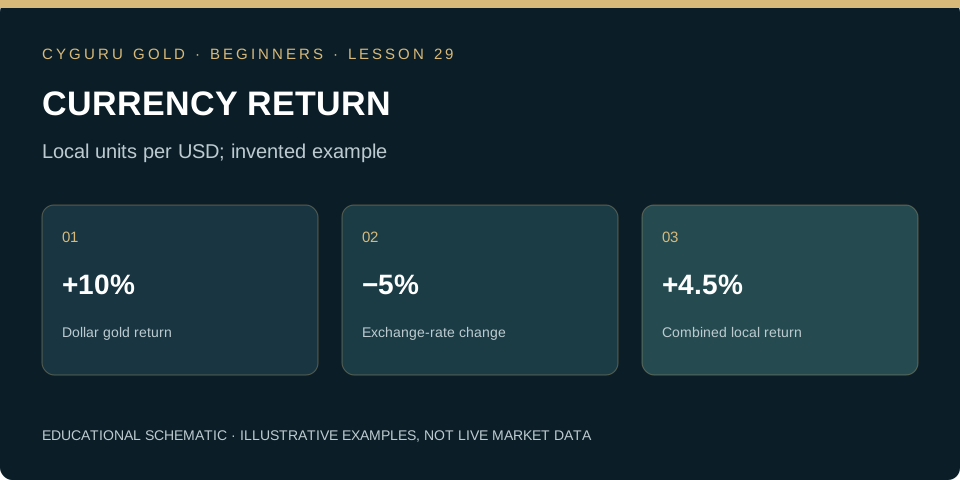
In a hypothetical example, gold rises from USD 2,000 to USD 2,200, while the exchange rate falls from 4.00 to 3.80 local units per dollar. The local ounce value moves from 8,000 to 8,360: a gain of 4.5%, before costs. Multiplying the return factors gives 1.10 × 0.95 − 1 = 0.045. Adding the separate 10% and −5% changes gives 5%, which misses the interaction term. These rates are invented and describe an unhedged reference calculation, not any particular currency’s current behavior.
Reconcile the investor’s actual result
The reference calculation excludes the dealer premium, bid–ask conversion spread, commissions, custody charges and other applicable costs. Record the amounts actually paid and received in the account’s reporting currency to calculate a cash result. A hedged product can have additional hedge costs and imperfect tracking, so the simple unhedged identity cannot be assigned to it without adjustment. For leveraged products, account margin and provider conversion rules introduce further mechanics. Keep those cases separate from a fully funded ounce holding.
Practice task: change the currency scenario
Keep gold’s hypothetical dollar return at +10%. Calculate the local reference return when local-units-per-dollar rises 5%, remains unchanged, or falls 5%. The answers are +15.5%, +10% and +4.5% before costs. Explain why a stronger dollar under this quotation convention raises the local gold reference. Then introduce a fictional conversion charge and reconcile the resulting cash amounts. Link this exercise with the premium lesson so a quoted gold return is not confused with the investor’s net round-trip result.
Can you apply the idea?
Answer three questions, then check the explanation for every answer. You can repeat the check after reviewing the lesson.
Knowledge check: not attempted
Make this lesson part of your process.
Finish the reading and its practice task, then mark the lesson as completed.
0 of 34 lessons completed
Gold Trading Mastery
From gold market fundamentals to technical analysis, execution, quantitative research and AI. A structured 160-chapter course.
Explore the book →Continue the beginner course
What Is XAU/USD? Gold Trading Explained for Beginners →
How to Read Gold Candlestick Charts: A Beginner’s Guide →
Market, Limit and Stop Orders in Gold Trading →
Gold Trading Costs: Spread, Slippage and Financing →
Stop-Loss and Take-Profit in Gold: Beginner Essentials →
Your First Gold Trading Plan: Practise Before Going Live →
Gold Position Sizing: Calculate Exposure Before You Trade →
Gold Leverage and Margin: Understand the Difference →
Support and Resistance in Gold: Read Zones Without Guessing →
Gold and the Economic Calendar: CPI, Jobs and the Fed →
Multiple-Timeframe Gold Analysis: Context, Setup and Trigger →
Gold Trading Expectancy: Evaluate Results Beyond Win Rate →
Gold Trends and Ranges: Identify the Market Before the Setup →
Gold ATR for Beginners: Measure Movement, Not Direction →
Gold Breakouts and Failed Breaks: Define the Evidence →
Gold Trading Drawdown: Understand Losses and Recovery →
How to Backtest a Gold Trading Rule Without Hindsight →
The Gold Pre-Trade Checklist: Turn a Plan into a Decision →
Gold Liquidity and Trading Sessions: Study the Conditions →
Audit a Gold Trade: Quotes, Triggers and Actual Fills →
Multiple Gold Positions: Measure the Combined Exposure →
Partial Exits and Breakeven Stops: Follow the Arithmetic →
Small Samples in Gold Trading: Describe the Uncertainty →
Your Gold Trading Review: Version the Rule Before Testing Again →
Gold Weight and Purity: Calculate the Fine Gold Content →
Gold Premiums and Buyback: Calculate the Round-Trip Hurdle →
Allocated and Unallocated Gold: Understand the Ownership Claim →
Gold Benchmarks and Spot Quotes: Compare Like with Like →
Gold Futures Tick Value: Translate Price Moves into Money →
Gold Futures Daily Settlement: Follow the Cash Through the Account →
Gold COT Reports: Read Positioning Without Inventing a Signal →
Gold ETFs: NAV, Market Price and Tracking Difference →
Gold in a Portfolio: Calculate Weight Drift and Rebalancing →
Market Desk and position-risk calculator →
Position sizing explained → · Build a trading journal →
Lesson sources and further study
World Gold Council: How to invest in different gold assets
Core course references
CME Group: Gold Product Overview. Investor.gov: Types of Orders explains order concepts for stocks; check the execution rules of your specific gold instrument.
Gabriel Nicolaev — CyGuru · Published 5 November 2026. Educational material. Illustrative prices are not current quotes or trade recommendations.