Gold in a Portfolio: Calculate Weight Drift and Rebalancing
Measure how a gold allocation changes with asset returns and cash flows, and distinguish a hypothetical rebalancing rule from a market forecast.
Define the portfolio before choosing a percentage
An allocation is the value assigned to an exposure as a share of the relevant portfolio. Specify which accounts and liabilities are included, the reporting currency and whether the exposure is fully funded or leveraged. A 10% cash allocation to bullion is not equivalent to depositing 10% as futures collateral. The same gold holding can also look small or large depending on what else belongs in the denominator. This lesson uses invented weights to teach arithmetic; it does not select an appropriate allocation for a particular investor.
Calculate weight drift after returns
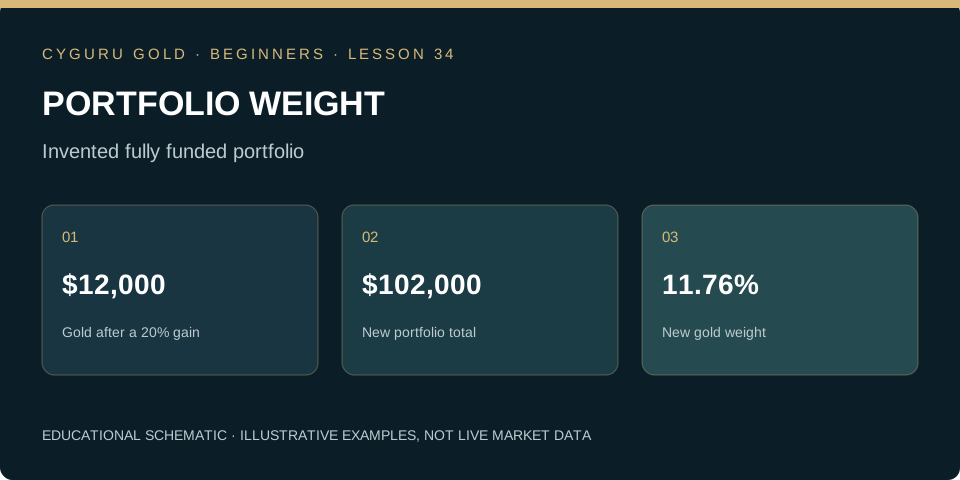
Imagine a USD 100,000 teaching portfolio with USD 10,000 in gold and USD 90,000 in other assets. If gold rises 20% and the other assets remain unchanged, gold becomes USD 12,000 and the portfolio becomes USD 102,000. Gold’s new weight is 12,000 ÷ 102,000 = approximately 11.76%. It has not become 12% of the current portfolio, because that would use the original denominator. Portfolio weights must be calculated from values measured at the same time and in the same reporting currency.
Translate a target into a transaction amount
If an illustrative rule restores a 10% gold weight immediately, the target gold value is 10% × USD 102,000 = USD 10,200. The model would transfer USD 1,800 from gold to the other assets before costs and constraints. Selling 2% of the original portfolio would produce a different amount. A purchase or sale instruction must also account for permitted units, spreads, fees and applicable tax consequences. A theoretical target may not be exactly executable, especially when indivisible physical products are involved.
Separate the rule from a prediction
Calendar rebalancing, tolerance bands and cash-flow-based adjustments are different methods. A rule should state its observation time, permitted deviation and transaction assumptions. Rebalancing reduces or increases exposure because of the allocation policy; it need not express a view that gold is about to reverse. It can underperform another method over some periods and incurs costs. A backtest must include those costs and preserve the rule used. Historical diversification patterns do not guarantee that every asset combination will protect capital during a future stress.
Practice task: use cash flows before trading
Return to the USD 102,000 portfolio and add an invented USD 8,000 contribution directed entirely to the other assets. Total value becomes USD 110,000 while gold remains USD 12,000, giving a 10.91% gold weight. Restoring the illustrative 10% target would now imply a USD 1,000 gold transfer before costs, rather than USD 1,800. Explain how an external cash flow changes the calculation. Finish by writing the rule, denominator, costs and data requirements you would preserve before testing an allocation policy.
Can you apply the idea?
Answer three questions, then check the explanation for every answer. You can repeat the check after reviewing the lesson.
Knowledge check: not attempted
Make this lesson part of your process.
Finish the reading and its practice task, then mark the lesson as completed.
0 of 34 lessons completed
Gold Trading Mastery
From gold market fundamentals to technical analysis, execution, quantitative research and AI. A structured 160-chapter course.
Explore the book →Continue the beginner course
What Is XAU/USD? Gold Trading Explained for Beginners →
How to Read Gold Candlestick Charts: A Beginner’s Guide →
Market, Limit and Stop Orders in Gold Trading →
Gold Trading Costs: Spread, Slippage and Financing →
Stop-Loss and Take-Profit in Gold: Beginner Essentials →
Your First Gold Trading Plan: Practise Before Going Live →
Gold Position Sizing: Calculate Exposure Before You Trade →
Gold Leverage and Margin: Understand the Difference →
Support and Resistance in Gold: Read Zones Without Guessing →
Gold and the Economic Calendar: CPI, Jobs and the Fed →
Multiple-Timeframe Gold Analysis: Context, Setup and Trigger →
Gold Trading Expectancy: Evaluate Results Beyond Win Rate →
Gold Trends and Ranges: Identify the Market Before the Setup →
Gold ATR for Beginners: Measure Movement, Not Direction →
Gold Breakouts and Failed Breaks: Define the Evidence →
Gold Trading Drawdown: Understand Losses and Recovery →
How to Backtest a Gold Trading Rule Without Hindsight →
The Gold Pre-Trade Checklist: Turn a Plan into a Decision →
Gold Liquidity and Trading Sessions: Study the Conditions →
Audit a Gold Trade: Quotes, Triggers and Actual Fills →
Multiple Gold Positions: Measure the Combined Exposure →
Partial Exits and Breakeven Stops: Follow the Arithmetic →
Small Samples in Gold Trading: Describe the Uncertainty →
Your Gold Trading Review: Version the Rule Before Testing Again →
Gold Weight and Purity: Calculate the Fine Gold Content →
Gold Premiums and Buyback: Calculate the Round-Trip Hurdle →
Allocated and Unallocated Gold: Understand the Ownership Claim →
Gold Benchmarks and Spot Quotes: Compare Like with Like →
Gold Returns in Your Currency: Separate Metal and FX Effects →
Gold Futures Tick Value: Translate Price Moves into Money →
Gold Futures Daily Settlement: Follow the Cash Through the Account →
Gold COT Reports: Read Positioning Without Inventing a Signal →
Gold ETFs: NAV, Market Price and Tracking Difference →
Market Desk and position-risk calculator →
Position sizing explained → · Build a trading journal →
Lesson sources and further study
Investor.gov: Asset allocation and rebalancing
World Gold Council: Portfolio simulation methodology
Core course references
CME Group: Gold Product Overview. Investor.gov: Types of Orders explains order concepts for stocks; check the execution rules of your specific gold instrument.
Gabriel Nicolaev — CyGuru · Published 5 November 2026. Educational material. Illustrative prices are not current quotes or trade recommendations.