Allocated and Unallocated Gold: Understand the Ownership Claim
Distinguish specific-bar allocation, unallocated metal balances and practical custody records before comparing gold storage arrangements.
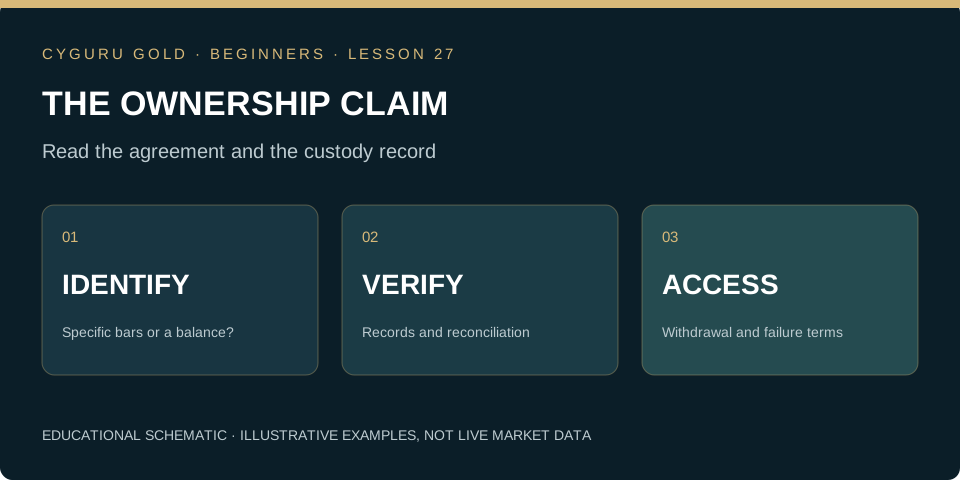
Identify the claim before admiring the metal
A screen showing a gold balance does not by itself describe the legal or operational arrangement underneath it. Allocated accounts generally identify particular metal held for a customer, while an unallocated account records a metal entitlement without assigning specific bars to that customer. Pooled or fractional arrangements require their own terms. Read the agreement rather than inferring ownership from a photograph, a balance label or the word backed. The central question is what you can claim, against whom, and under which conditions.
Use an evidence checklist for allocation
For a specific-bar arrangement, ask what identifies the bars: serial number, refiner, weight and fineness, together with the custody record and reconciliation process. Establish who holds the metal, whether subcustodians are used and what access or withdrawal conditions apply. An audit statement has a date, scope and method; it is not automatically a continuous guarantee. A bar list can support reconciliation, but a list alone does not settle every legal question about title, competing claims or insolvency treatment.
Separate price exposure from access to metal
Consider two hypothetical records, each representing ten ounces of gold price exposure. One assigns identified bars under stated custody terms. The other is an unallocated balance owed by an intermediary. A USD 10-per-ounce price change could change each marked balance by USD 100, before costs, yet the counterparty exposure and delivery process may differ. Similar price arithmetic therefore does not make the claims equivalent. Ask how the balance is converted to physical metal, what minimums apply and whether conversion adds delays or fees.
Read withdrawal and failure procedures
Storage is an ongoing relationship. Review insurance scope, exclusions, charges, transfer instructions, identity checks and the process for disputed records. Confirm what happens if the provider, custodian or a subcustodian stops operating. Do not assume that the word allocated gives the same protection in every jurisdiction or contract. Independent professional advice may be needed for a material arrangement. This lesson supplies questions for reading the documents; it does not determine the enforceability of a particular provider’s promises.
Practice task: build a claim comparison
Create two imaginary product summaries and compare their ownership description, bar identification, intermediary exposure, fees, minimum withdrawal, timing and available verification. Mark unanswered questions explicitly. If one summary says fully backed but gives no account type, do not fill the gap with an assumed allocation model. Write a short explanation of why an equivalent displayed ounce balance can conceal different access and failure risks. Keep this worksheet alongside the premium comparison so operational terms and headline price are evaluated together.
Can you apply the idea?
Answer three questions, then check the explanation for every answer. You can repeat the check after reviewing the lesson.
Knowledge check: not attempted
Make this lesson part of your process.
Finish the reading and its practice task, then mark the lesson as completed.
0 of 34 lessons completed
Gold Trading Mastery
From gold market fundamentals to technical analysis, execution, quantitative research and AI. A structured 160-chapter course.
Explore the book →Continue the beginner course
What Is XAU/USD? Gold Trading Explained for Beginners →
How to Read Gold Candlestick Charts: A Beginner’s Guide →
Market, Limit and Stop Orders in Gold Trading →
Gold Trading Costs: Spread, Slippage and Financing →
Stop-Loss and Take-Profit in Gold: Beginner Essentials →
Your First Gold Trading Plan: Practise Before Going Live →
Gold Position Sizing: Calculate Exposure Before You Trade →
Gold Leverage and Margin: Understand the Difference →
Support and Resistance in Gold: Read Zones Without Guessing →
Gold and the Economic Calendar: CPI, Jobs and the Fed →
Multiple-Timeframe Gold Analysis: Context, Setup and Trigger →
Gold Trading Expectancy: Evaluate Results Beyond Win Rate →
Gold Trends and Ranges: Identify the Market Before the Setup →
Gold ATR for Beginners: Measure Movement, Not Direction →
Gold Breakouts and Failed Breaks: Define the Evidence →
Gold Trading Drawdown: Understand Losses and Recovery →
How to Backtest a Gold Trading Rule Without Hindsight →
The Gold Pre-Trade Checklist: Turn a Plan into a Decision →
Gold Liquidity and Trading Sessions: Study the Conditions →
Audit a Gold Trade: Quotes, Triggers and Actual Fills →
Multiple Gold Positions: Measure the Combined Exposure →
Partial Exits and Breakeven Stops: Follow the Arithmetic →
Small Samples in Gold Trading: Describe the Uncertainty →
Your Gold Trading Review: Version the Rule Before Testing Again →
Gold Weight and Purity: Calculate the Fine Gold Content →
Gold Premiums and Buyback: Calculate the Round-Trip Hurdle →
Gold Benchmarks and Spot Quotes: Compare Like with Like →
Gold Returns in Your Currency: Separate Metal and FX Effects →
Gold Futures Tick Value: Translate Price Moves into Money →
Gold Futures Daily Settlement: Follow the Cash Through the Account →
Gold COT Reports: Read Positioning Without Inventing a Signal →
Gold ETFs: NAV, Market Price and Tracking Difference →
Gold in a Portfolio: Calculate Weight Drift and Rebalancing →
Market Desk and position-risk calculator →
Position sizing explained → · Build a trading journal →
Lesson sources and further study
World Gold Council: Investment glossary
Core course references
CME Group: Gold Product Overview. Investor.gov: Types of Orders explains order concepts for stocks; check the execution rules of your specific gold instrument.
Gabriel Nicolaev — CyGuru · Published 5 November 2026. Educational material. Illustrative prices are not current quotes or trade recommendations.