Gold and Currency Hedging: Separate Metal Exposure from the Conversion Leg
Calculate a gold holding in a second currency and show why a fixed-size currency hedge leaves metal-linked and cash-flow residuals.
Name the currency in which the objective is measured
A holder of dollar-priced gold can care about wealth, liabilities or spending in another currency. Gold price exposure and currency conversion exposure are separate drivers of the local value. Define the exchange rate direction explicitly: this lesson uses local-currency units per US dollar, so local value equals ounces multiplied by dollar gold price multiplied by that rate. Reversing the quotation requires a different calculation. A product listed in local currency is not automatically hedged, and a fixed exchange-rate assumption is not a substitute for reading the actual exposure and hedging policy.
Calculate the unhedged two-factor result
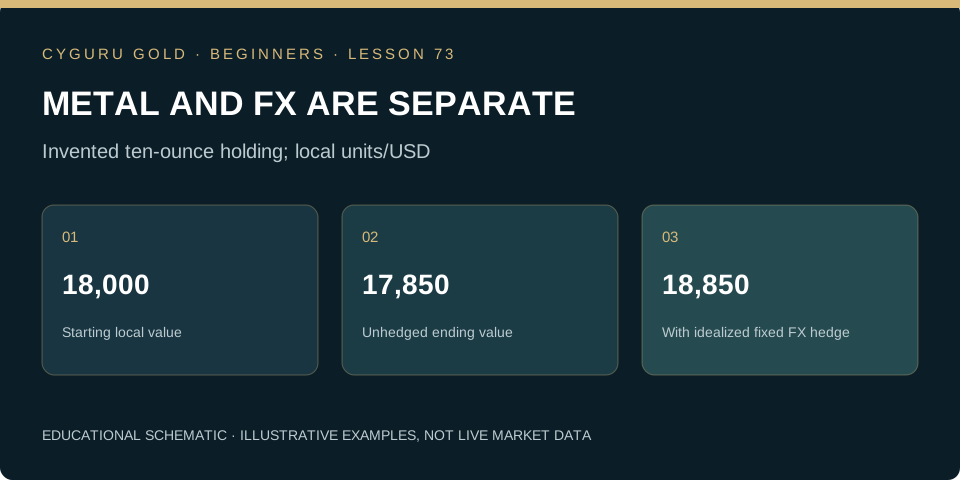
Use an invented holding of 10 ounces at USD 2,000 per ounce and an exchange rate of 0.90 local units per dollar. Starting local value is 18,000. Later gold rises to USD 2,100 while the rate falls to 0.85. Dollar metal value becomes USD 21,000, but local value is 17,850. The local loss is 150, or approximately −0.8333%, even though dollar gold rose 5%. Multiplying growth factors, 1.05 × (0.85/0.90) − 1, gives the same return. Adding the percentage changes without their interaction term would produce a different result.
Use a deliberately idealized currency offset
Imagine an initial-USD-value hedge that sells a fixed USD 20,000 forward against local currency at a fictional rate of 0.90 for the same horizon. At a maturity spot rate of 0.85, its simplified settlement-equivalent local gain is 20,000 × (0.90−0.85) = 1,000. Combining that with the 17,850 local metal value gives 18,850, compared with the initial 18,000, before costs. This teaching forward rate is an assumption, not a market quote. Actual forward points, settlement, collateral and closeout conventions must be specified. The hedge fixes conversion for one notional rather than every future dollar value the metal might reach.
| Component | Calculation | Local value / gain |
|---|---|---|
| Initial gold | 10×2,000×0.90 | 18,000 |
| Terminal unhedged gold | 10×2,100×0.85 | 17,850 |
| Idealized fixed FX hedge | 20,000×(0.90−0.85) | +1,000 |
| Combined terminal value | 17,850+1,000 | 18,850 |
| All terminal dollars at 0.90 | 21,000×0.90 | 18,900; difference 50 |
Explain the residual instead of calling the hedge perfect
If the metal’s entire terminal USD 21,000 value could be converted at 0.90, local value would be 18,900. The fixed USD 20,000 hedge example instead produces 18,850, a difference of 50. That is the changed dollar value of the holding interacting with the remaining exchange-rate movement: the extra USD 1,000 was not included in the original fixed hedge notional. Rebalancing can change the residual but creates transactions and timing effects. A currency hedge can also generate a payable cash flow when the exchange rate moves the other way, so its marked gain or loss must be financed independently of a stored asset.
Distinguish policy, instrument and evidence
A hedge ratio can target starting value, a periodically updated value or a liability schedule. Those policies produce different transactions and outcomes. Currency forwards, futures and other products have different specifications and counterparty arrangements; a generic formula does not establish their suitability or availability. Check that the conversion leg’s maturity matches the intended horizon and that any early sale or withdrawal is handled. Report metal return, FX contribution, hedge cash flow and costs separately. Do not claim that currency hedging always improves performance: it changes the risk being retained and can remove favorable currency effects as well as adverse ones.
Practice task: reconcile the local-currency ledger
Reproduce starting 18,000, unhedged ending 17,850 and the idealized 1,000 local-currency hedge gain. Verify the combined 18,850 and explain the 50 residual versus full terminal-value conversion at 0.90. Add fields for actual forward rate, hedge notional, maturity, fees and collateral, leaving unknown contract terms unresolved. Finish by describing what changes if the holder sells half the gold early. The exercise is complete when the metal holding and conversion obligation remain understandable as separate positions rather than hidden inside one apparently stable local-price line.
Can you apply the idea?
Answer three questions, then check the explanation for every answer. You can repeat the check after reviewing the lesson.
Knowledge check: not attempted
Make this lesson part of your process.
Finish the reading and its practice task, then mark the lesson as completed.
0 of 100 lessons completed
Gold Trading Mastery
From gold market fundamentals to technical analysis, execution, quantitative research and AI. A structured 160-chapter course.
Explore the book →Continue the beginner course
What Is XAU/USD? Gold Trading Explained for Beginners →
How to Read Gold Candlestick Charts: A Beginner’s Guide →
Market, Limit and Stop Orders in Gold Trading →
Gold Trading Costs: Spread, Slippage and Financing →
Stop-Loss and Take-Profit in Gold: Beginner Essentials →
Your First Gold Trading Plan: Practise Before Going Live →
Gold Position Sizing: Calculate Exposure Before You Trade →
Gold Leverage and Margin: Understand the Difference →
Support and Resistance in Gold: Read Zones Without Guessing →
Gold and the Economic Calendar: CPI, Jobs and the Fed →
Multiple-Timeframe Gold Analysis: Context, Setup and Trigger →
Gold Trading Expectancy: Evaluate Results Beyond Win Rate →
Gold Trends and Ranges: Identify the Market Before the Setup →
Gold ATR for Beginners: Measure Movement, Not Direction →
Gold Breakouts and Failed Breaks: Define the Evidence →
Gold Trading Drawdown: Understand Losses and Recovery →
How to Backtest a Gold Trading Rule Without Hindsight →
The Gold Pre-Trade Checklist: Turn a Plan into a Decision →
Gold Liquidity and Trading Sessions: Study the Conditions →
Audit a Gold Trade: Quotes, Triggers and Actual Fills →
Multiple Gold Positions: Measure the Combined Exposure →
Partial Exits and Breakeven Stops: Follow the Arithmetic →
Small Samples in Gold Trading: Describe the Uncertainty →
Your Gold Trading Review: Version the Rule Before Testing Again →
Gold Weight and Purity: Calculate the Fine Gold Content →
Gold Premiums and Buyback: Calculate the Round-Trip Hurdle →
Allocated and Unallocated Gold: Understand the Ownership Claim →
Gold Benchmarks and Spot Quotes: Compare Like with Like →
Gold Returns in Your Currency: Separate Metal and FX Effects →
Gold Futures Tick Value: Translate Price Moves into Money →
Gold Futures Daily Settlement: Follow the Cash Through the Account →
Gold COT Reports: Read Positioning Without Inventing a Signal →
Gold ETFs: NAV, Market Price and Tracking Difference →
Gold in a Portfolio: Calculate Weight Drift and Rebalancing →
Gold Moving Averages: Read Smoothing Without Predicting the Future →
Gold RSI: Momentum Is Not a Reversal Promise →
Gold Volume: Distinguish Ticks, Contracts and Coverage →
Gold Heikin Ashi Charts: Separate Display Prices from Fills →
Gold Indicator Repainting: Distinguish Live Signals from Confirmed History →
Gold Backtests: When One Candle Touches Both Stop and Target →
Gold TradingView Alerts: Audit the Saved Script Snapshot →
Gold Signal Webhooks: Verify Delivery, Freshness and Duplicates →
Gold Trading Returns: Add Money, Compound Percentages →
Gold Account Performance: Separate Deposits from Trading Gains →
Gold Realized Volatility: Calculate the Statistic and Audit Its Assumptions →
Gold Correlation: Align Returns Before Interpreting the Relationship →
Gold Event Studies: Measure the Reaction Without Inventing the Cause →
Gold Strategy Robustness: Count the Experiments Behind the Winner →
Gold Stress Tests: Model Gaps, Liquidity and Tail Losses Together →
Gold Options at Expiry: Separate Payoff, Premium and Exercise →
Gold Option Delta and Gamma: Estimate Exposure Without Freezing It →
Gold Implied Volatility: Separate the Price of Uncertainty from Direction →
Gold Futures Rolls: Reconcile Contract P&L with a Continuous Chart →
Gold Mining Shares: Understand the Business Behind the Metal Exposure →
Gold VWAP: Define the Anchor, Price Input and Volume →
Gold Bollinger Bands: Distinguish Price Dispersion from a Reversal Signal →
Gold MACD: Read the Line, Signal and Histogram as Different Comparisons →
Gold Donchian Channels: Use the Prior Window Without Circular Signals →
Gold Fibonacci Retracements: Audit the Anchors Before Trusting the Level →
Gold Position Accounting: Distinguish Net Exposure from Gross Tickets →
Gold Bracket Orders: Audit Partial Fills and Cancellation States →
Gold Trade Excursions: Measure MAE and MFE Without Rewriting the Past →
Gold Execution Shortfall: Reconcile Decisions, Fills and Unfilled Quantity →
Gold Strategy Monitoring: Separate Data Failures, Execution Drift and Method Decay →
Gold Open Interest: Follow the Contract Ledger Before Reading Sentiment →
Gold Order Books: Translate Displayed Depth into a Conditional Fill Estimate →
Gold Calendar Spreads: Calculate Relative-Maturity P&L and Leg Risk →
Gold Basis Risk: Explain Why a Futures Hedge Can Leave a Residual Loss →
Gold Lending and Lease Rates: Separate Metal Interest from Price Exposure →
Gold Assay and Authenticity: Separate a Purity Calculation from Evidence →
Gold Storage and Insurance: Reconcile the Inventory and the Protection →
Gold Inventory Hedging: Match Fine Ounces and Finance the Cash Path →
Gold Capstone: Build One Report from Price, Basis, Costs and Liquidity →
Gold Profit Factor: Reconcile the Winning and Losing Dollars →
Gold Sharpe Ratios: Align Excess Returns, Frequency and Risk →
Gold Sortino Ratios: Define the Target and the Downside Denominator →
Gold Win Rates: Calculate a Confidence Interval and State Its Assumptions →
Gold Return Dependence: Keep the Sequence When Measuring Risk →
Gold Bootstrap Studies: Resample the Evidence Without Inventing New Markets →
Gold Walk-Forward Tests: Freeze Each Rule Before Its Next Evaluation →
Gold Research Universes: Keep Delisted Products and Historical Eligibility Visible →
Gold Performance Attribution: Separate Within-Condition Results from the Opportunity Mix →
Gold Performance Capstone: Audit a Claim from Signal Ledger to Account Equity →
Build a Gold Trading System: Write the Operating Charter Before the Signal →
Gold Setup Rules: Translate Chart Language into Testable Predicates →
Gold System States: Separate Eligibility, Submission, Exposure and Rearming →
Gold System Sizing: Reserve Risk and Check Whether a Trade Is Feasible →
Gold System Exits: Define Priority, Timeouts and Conflicting Events →
Release a Gold Paper System: Test the Runbook Before Increasing Exposure →
Gold Execution Hesitation: Distinguish a Missed Entry from a New Decision →
Gold Overtrading: Audit Eligibility Before Counting Activity →
Gold Losing Streaks: Prevent Recovery Pressure from Rewriting Risk →
Gold Rule Changes: Separate Emergency Repairs from Strategy Redesign →
Gold Trading Journals: Score Decision Quality Separately from Profit →
Gold Case Study: Audit a Trend-Continuation Trade from Context to Net Exit →
Gold Case Study: Accept a Failed Range Break Without Moving the Evidence →
Gold Case Study: Document a Valid No-Trade Decision Around a Scheduled Event →
Gold Case Study: Recover from a Lost Order Response Without Duplicating Exposure →
Gold Lesson 100: Complete the Paper-System Project and Defend Its Evidence →
Market Desk and position-risk calculator →
Position sizing explained → · Build a trading journal →
Lesson sources and further study
World Gold Council: Gold assets and exposure structures
CME Group: Currency overlays and separate asset/FX exposures
Core course references
CME Group: Gold Product Overview. Investor.gov: Types of Orders explains order concepts for stocks; check the execution rules of your specific gold instrument.
Gabriel Nicolaev — CyGuru · Published 7 November 2026. Educational material. Illustrative prices are not current quotes or trade recommendations.