Gold Options at Expiry: Separate Payoff, Premium and Exercise
Calculate hypothetical call and put outcomes, distinguish moneyness from profitability and inspect the contract’s exercise and settlement terms.
An option is a contract with an expiry
A call gives its holder a contractual right associated with buying the underlying at the strike, and a put a right associated with selling it, subject to the product’s exercise and settlement rules. Gold options can reference futures rather than physical retail bars or a broker’s spot quote. Identify the exact underlying, multiplier, strike, expiry, exercise style and settlement process before drawing a payoff. This lesson uses simplified expiry-value arithmetic for hypothetical contracts. It is not an order recommendation and does not describe every exchange’s operational handling.
Calculate a purchased call after its premium
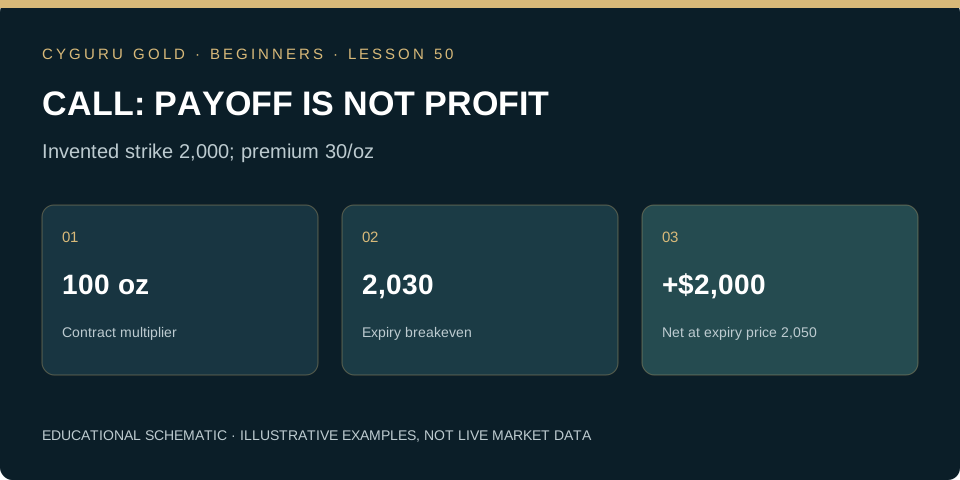
Assume an invented call with strike 2,000, premium quoted at USD 30 per ounce and multiplier 100 ounces. Upfront premium is USD 3,000 before fees. If the referenced underlying value at expiry is 2,050, intrinsic value is 50 per ounce, or USD 5,000. Subtracting the premium leaves USD 2,000 before costs. If expiry value is 2,020, the call is in the money by 20 per ounce, yet net result is a USD 1,000 loss. Moneyness describes the strike relationship; profitability also includes the amount paid. Simplified expiry breakeven is 2,030 before other charges.
Compare the put with the same discipline
For an invented purchased put with strike 2,000, premium 25 per ounce and multiplier 100, premium cost is USD 2,500. At an expiry reference of 1,950, intrinsic value is 50 per ounce and net result is USD 2,500 before fees. At 2,010, the simplified intrinsic payoff is zero and the premium is lost. Breakeven is 1,975 under these assumptions. The call uses max(underlying minus strike, zero); the put uses max(strike minus underlying, zero). Label whether a displayed chart shows gross payoff or net profit, because the two lines cross zero at different places.
| Underlying reference | Gross intrinsic payoff | Premium paid | Net before costs |
|---|---|---|---|
| 1,950 | $0 | $3,000 | −$3,000 |
| 2,000 | $0 | $3,000 | −$3,000 |
| 2,020 | $2,000 | $3,000 | −$1,000 |
| 2,030 | $3,000 | $3,000 | $0 |
| 2,050 | $5,000 | $3,000 | +$2,000 |
Do not use the expiry diagram as a live quote model
Before expiry, option value reflects time remaining, implied volatility and other model inputs as well as the underlying price. A call can lose value even when gold rises if other changes offset its directional benefit. The terminal payoff diagram does not predict tomorrow’s tradable bid, and a theoretical mid-price may differ from an executable exit. Record the bid-ask spread and premium quotation convention. A percentage gain on the premium is also different from a percentage move in gold, a return on total account equity or a return on collateral supporting a wider portfolio.
Understand what changes when exercise occurs
A purchased option’s standalone premium loss is limited to the premium paid, before additional costs, when considering its option payoff. Exercise or assignment mechanics can create or alter an underlying futures position, which introduces its own margin and subsequent price risk. Short-option exposure is a different obligation and can create losses far beyond collected premium. Read automatic-exercise procedures, decision deadlines and broker restrictions instead of assuming that doing nothing always means the position disappears harmlessly. A beginner should resolve these terms before any funded transaction, not on the final afternoon of expiry.
Practice task: make a five-price expiry table
For the call above, calculate intrinsic payoff and net P&L at underlying values 1,950, 2,000, 2,020, 2,030 and 2,050. Your net results before fees should be −3,000, −3,000, −1,000, zero and +2,000 dollars. Repeat for the put, using its own premium. Add a column for the multiplier and a separate note that operational exercise may establish a futures position. Explain why being correct about direction is insufficient when the move fails to exceed the premium hurdle. Continue to delta only after these terminal cash calculations are clear.
Can you apply the idea?
Answer three questions, then check the explanation for every answer. You can repeat the check after reviewing the lesson.
Knowledge check: not attempted
Make this lesson part of your process.
Finish the reading and its practice task, then mark the lesson as completed.
0 of 54 lessons completed
Gold Trading Mastery
From gold market fundamentals to technical analysis, execution, quantitative research and AI. A structured 160-chapter course.
Explore the book →Continue the beginner course
What Is XAU/USD? Gold Trading Explained for Beginners →
How to Read Gold Candlestick Charts: A Beginner’s Guide →
Market, Limit and Stop Orders in Gold Trading →
Gold Trading Costs: Spread, Slippage and Financing →
Stop-Loss and Take-Profit in Gold: Beginner Essentials →
Your First Gold Trading Plan: Practise Before Going Live →
Gold Position Sizing: Calculate Exposure Before You Trade →
Gold Leverage and Margin: Understand the Difference →
Support and Resistance in Gold: Read Zones Without Guessing →
Gold and the Economic Calendar: CPI, Jobs and the Fed →
Multiple-Timeframe Gold Analysis: Context, Setup and Trigger →
Gold Trading Expectancy: Evaluate Results Beyond Win Rate →
Gold Trends and Ranges: Identify the Market Before the Setup →
Gold ATR for Beginners: Measure Movement, Not Direction →
Gold Breakouts and Failed Breaks: Define the Evidence →
Gold Trading Drawdown: Understand Losses and Recovery →
How to Backtest a Gold Trading Rule Without Hindsight →
The Gold Pre-Trade Checklist: Turn a Plan into a Decision →
Gold Liquidity and Trading Sessions: Study the Conditions →
Audit a Gold Trade: Quotes, Triggers and Actual Fills →
Multiple Gold Positions: Measure the Combined Exposure →
Partial Exits and Breakeven Stops: Follow the Arithmetic →
Small Samples in Gold Trading: Describe the Uncertainty →
Your Gold Trading Review: Version the Rule Before Testing Again →
Gold Weight and Purity: Calculate the Fine Gold Content →
Gold Premiums and Buyback: Calculate the Round-Trip Hurdle →
Allocated and Unallocated Gold: Understand the Ownership Claim →
Gold Benchmarks and Spot Quotes: Compare Like with Like →
Gold Returns in Your Currency: Separate Metal and FX Effects →
Gold Futures Tick Value: Translate Price Moves into Money →
Gold Futures Daily Settlement: Follow the Cash Through the Account →
Gold COT Reports: Read Positioning Without Inventing a Signal →
Gold ETFs: NAV, Market Price and Tracking Difference →
Gold in a Portfolio: Calculate Weight Drift and Rebalancing →
Gold Moving Averages: Read Smoothing Without Predicting the Future →
Gold RSI: Momentum Is Not a Reversal Promise →
Gold Volume: Distinguish Ticks, Contracts and Coverage →
Gold Heikin Ashi Charts: Separate Display Prices from Fills →
Gold Indicator Repainting: Distinguish Live Signals from Confirmed History →
Gold Backtests: When One Candle Touches Both Stop and Target →
Gold TradingView Alerts: Audit the Saved Script Snapshot →
Gold Signal Webhooks: Verify Delivery, Freshness and Duplicates →
Gold Trading Returns: Add Money, Compound Percentages →
Gold Account Performance: Separate Deposits from Trading Gains →
Gold Realized Volatility: Calculate the Statistic and Audit Its Assumptions →
Gold Correlation: Align Returns Before Interpreting the Relationship →
Gold Event Studies: Measure the Reaction Without Inventing the Cause →
Gold Strategy Robustness: Count the Experiments Behind the Winner →
Gold Stress Tests: Model Gaps, Liquidity and Tail Losses Together →
Gold Option Delta and Gamma: Estimate Exposure Without Freezing It →
Gold Implied Volatility: Separate the Price of Uncertainty from Direction →
Gold Futures Rolls: Reconcile Contract P&L with a Continuous Chart →
Gold Mining Shares: Understand the Business Behind the Metal Exposure →
Market Desk and position-risk calculator →
Position sizing explained → · Build a trading journal →
Lesson sources and further study
CME Group: Options moneyness and intrinsic value
CME Group: Options on futures basics
Core course references
CME Group: Gold Product Overview. Investor.gov: Types of Orders explains order concepts for stocks; check the execution rules of your specific gold instrument.
Gabriel Nicolaev — CyGuru · Published 6 November 2026. Educational material. Illustrative prices are not current quotes or trade recommendations.