A range boundary under pressure
Understand why an eligible entry can still lose.
Illustrative simulation · No historical performance claim01. Read the information available.
Recent simulated closes have overlapped between a lower and upper reference area. A documented short setup at the upper area is assumed to have qualified on the last visible candle. Prior interaction supplies context; it does not guarantee that the boundary will hold.
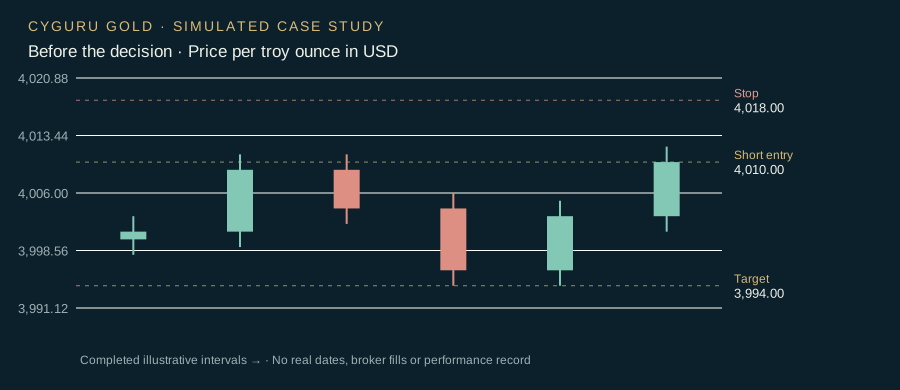
02. Apply the documented plan.
The example permits a short at 4,010, a stop at 4,018 and a target at 3,994. The stop is the predetermined failure condition. Assume the stated entry and an exit at the first stop or target touched, before costs.
Stop touched · -1R before costs
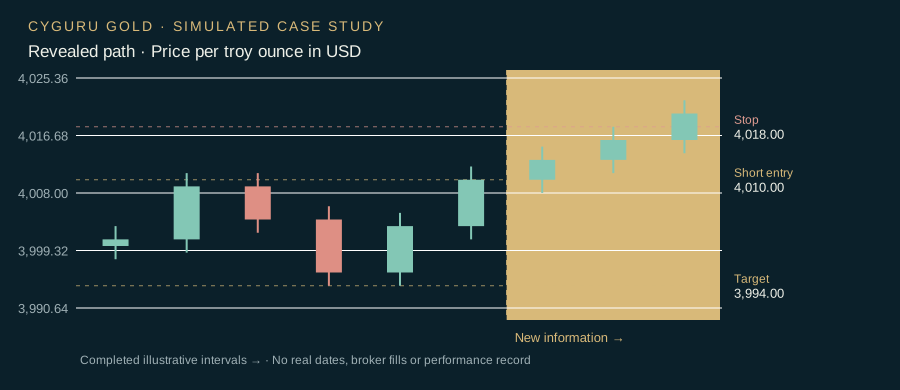
The new simulated candles rise through the stop at 4,018 before reaching the target. At the assumed stop fill, the short loses USD 8 per ounce: -1R. A price area can be respected earlier and fail on the next qualifying attempt.
What this case teaches
A valid decision rule can produce a loss. Review whether the boundary and stop were specified before entry, whether the quantity fit the budget and whether the execution matched the assumptions. Do not redraw the boundary to erase the failure.
Your reviewed scenarios are saved in this browser.