The message arrives after the event window
Distinguish original signal time, delivery time and inclusive event-window boundaries.
Illustrative simulation · No historical performance claim01. Read the information available.
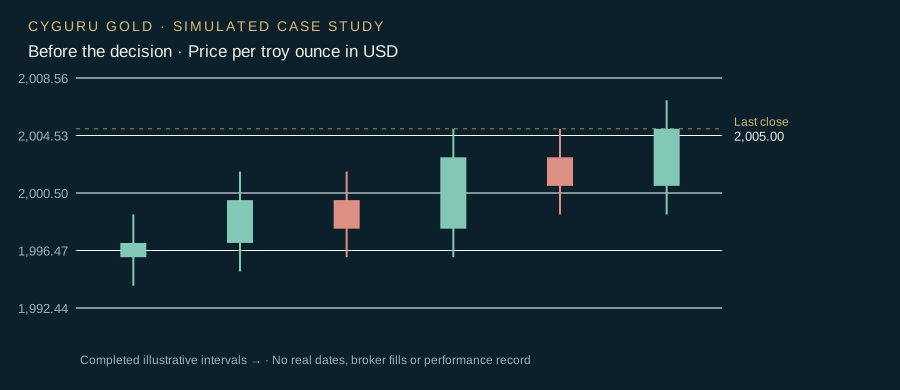
A synthetic release is scheduled at 12:30 UTC. The charter excludes new entries from 12:15 through 12:45 inclusive. A setup event generated at 12:20 arrives at 12:46. The chart is illustrative and has no real date; the timestamp facts, not a visually quiet candle, determine this gate.
02. Apply the documented plan.
An event blocked at its original decision time does not become a fresh signal through delayed delivery. A timestamp exactly 12:45 is also inside the declared inclusive window. At 12:46, only a new unexpired setup may proceed to all the other gates; the clock alone does not establish acceptable spread or data quality.
Delayed old event remains blocked
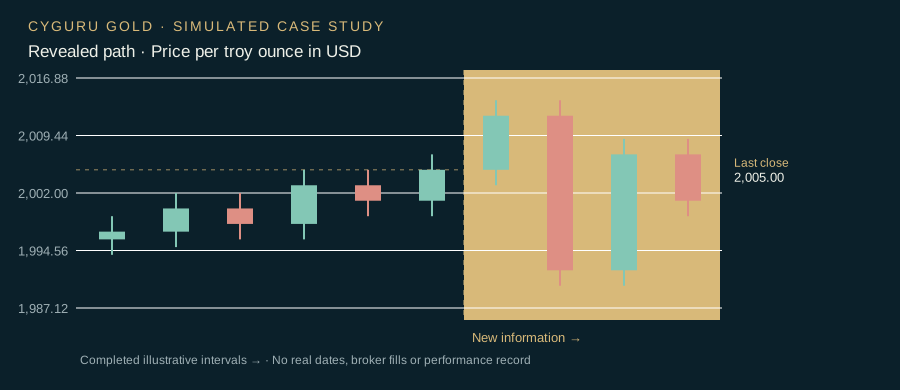
The timeline contains three distinct facts: generation at 12:20, scheduled release at 12:30 and delivery at 12:46. The exclusion includes 12:45, while a genuinely new 12:46 event is outside this gate only. No position is opened from the delayed event, so no executed result is assigned. The synthetic expansion after the cutoff illustrates uncertainty rather than reproducing an actual economic announcement.
Reproduce the calculation
| Component | Calculation or state |
|---|---|
| Window | 12:15–12:45 UTC inclusive |
| Generated | 12:20; blocked |
| Delivered | 12:46; old event |
| Next requirement | Fresh setup plus all gates |
Use the case facts and their units. Chart movement alone does not prove execution or account cash flows.
What this case teaches
Store event and receipt timestamps separately. A backlog after an outage should not convert stale messages into a burst of newly authorized exposure.
Your reviewed scenarios are saved in this browser.