Two programs have already reserved the budget
Check the aggregate ceiling before allowing a new eligible intention.
Illustrative simulation · No historical performance claim01. Read the information available.
An otherwise eligible third setup appears. Existing programs A and B reserve USD 30 and USD 25 respectively under the paper policy. Some entry quantities may still be working, so risk reservations cannot be released simply because a fill is absent from the local screen.
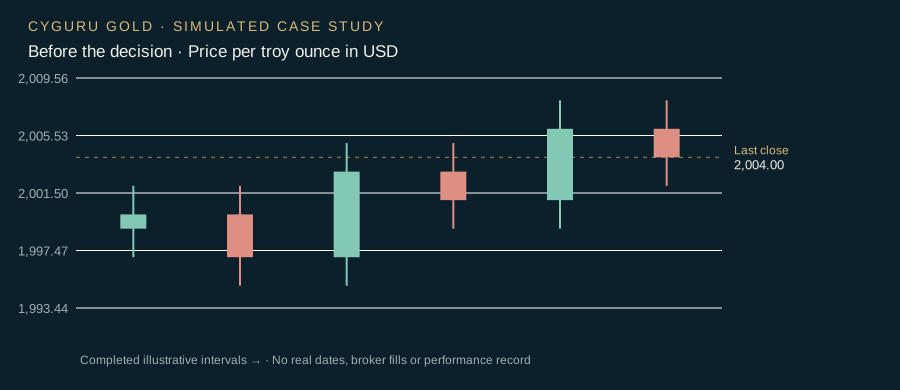
02. Apply the documented plan.
The frozen aggregate planning ceiling is USD 50. Accept no additional exposure while commitments exceed it. Reconcile current orders and follow the existing-position procedure; do not assume that blocking entries automatically closes positions or cancels protection.
New exposure blocked; existing state requires reconciliation
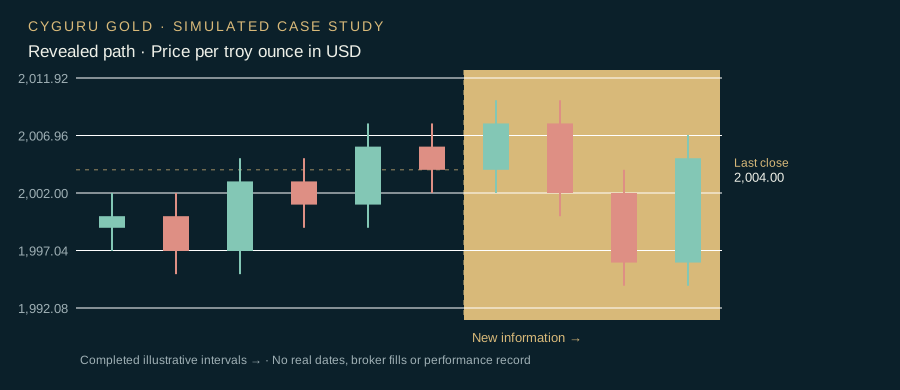
The recorded planning commitments total USD 55 against USD 50 capacity. The subsequent synthetic path is mixed and does not validate an unauthorized third order. This exercise assigns no additional program and no extra trading P&L. An operator must still resolve why the pre-existing commitments exceeded the policy and manage actual open exposure through the documented workflow.
Reproduce the calculation
| Component | Calculation or state |
|---|---|
| Program A | USD 30 reserved |
| Program B | USD 25 reserved |
| Total | USD 55 |
| Ceiling / excess | USD 50 / USD 5 |
Use the case facts and their units. Chart movement alone does not prove execution or account cash flows.
What this case teaches
Concurrent intentions can spend the same apparent budget unless reservations are coordinated. Aggregate risk control needs one consistent ledger, while gaps and dependence require a separate stress view.
Your reviewed scenarios are saved in this browser.