A partial target is not the whole result
Choose the declared exit policy, then reconcile both legs and total fees.
Illustrative simulation · No historical performance claim01. Read the information available.
A synthetic four-ounce long is confirmed filled at 2,000. The original stop trigger is 1,990 and the declared first target is 2,010 for two ounces. No subsequent candles are visible yet. This case studies a predetermined partial-exit and timeout policy, not whether that policy outperforms a full exit.
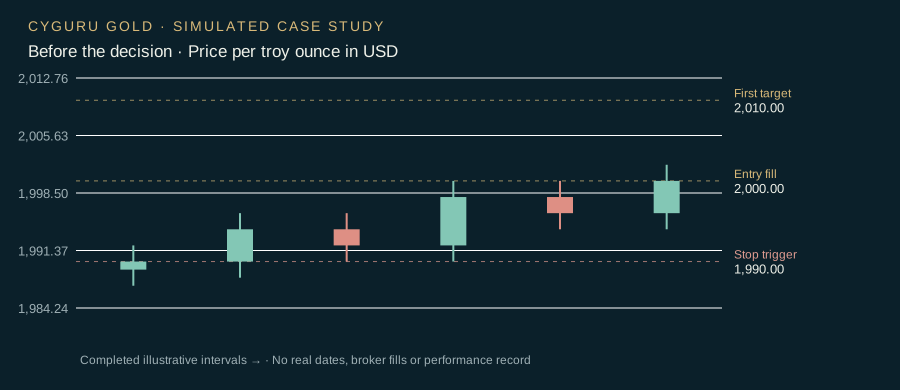
02. Apply the documented plan.
Close two ounces at a confirmed 2,010 target fill. Close the remaining two after the specified timeout at the then-available fill. There is no automatic stop move in this profile. Total explicit fees for the completed program are USD 2. Preserve original quantity and reconcile every exit.
Two confirmed exits produce USD 28 net
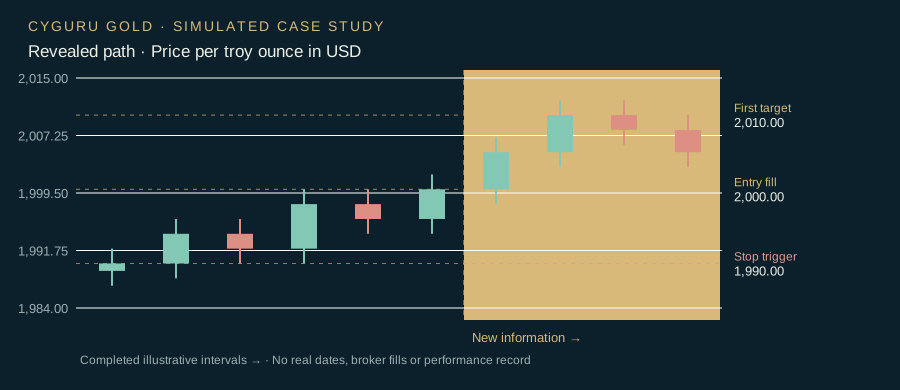
For the revealed ledger, assume two ounces fill at 2,010 and the remaining two at 2,005 at timeout. Gross P&L is 2×10+2×5=USD 30. Subtract USD 2 explicit fees once to obtain USD 28 net. These stipulated fills are additional case facts; a candle touching a level alone would not prove execution. Four ounces entered and four exited, so no position remains in this constructed ledger.
Reproduce the calculation
| Component | Calculation or state |
|---|---|
| First two ounces | 2×10 = USD 20 |
| Remaining two | 2×5 = USD 10 |
| Gross / fees | USD 30 / USD 2 |
| Net | USD 28 |
Use the case facts and their units. Chart movement alone does not prove execution or account cash flows.
What this case teaches
A partial target badge cannot summarize the full program. Evaluate the remaining exposure, costs and exit rule rather than counting the first target touch as completion.
Your reviewed scenarios are saved in this browser.