A stop trigger cannot promise its fill
Preserve a valid stop instruction while distinguishing planned and realized loss.
Illustrative simulation · No historical performance claim01. Read the information available.
A hypothetical four-ounce long has entered at 2,012. A stop trigger at 2,002 is active in the stipulated paper order ledger. The planning calculation reserved USD 1 per ounce adverse execution and USD 2 total explicit fees, giving USD 46 estimated loss. The continuation is unknown at the decision cutoff.
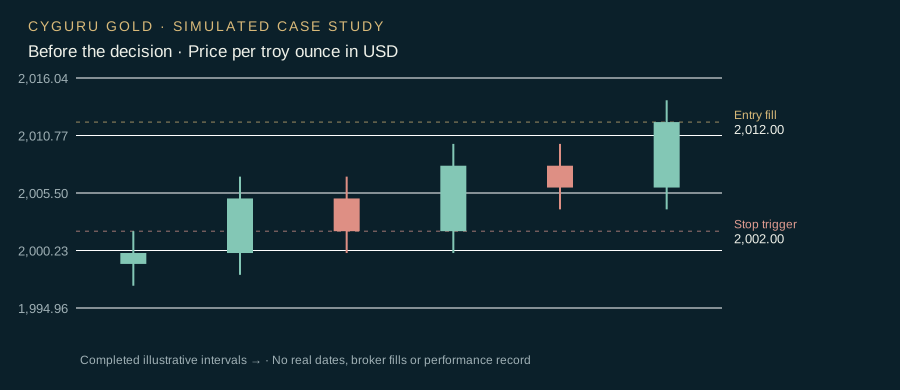
02. Apply the documented plan.
Keep the declared protective policy. Do not remove the stop or add exposure to defend the entry. Realized reporting must use confirmed fills, including an adverse gap if one occurs; the allowance is not an execution guarantee.
Adverse fill: USD 58 net loss
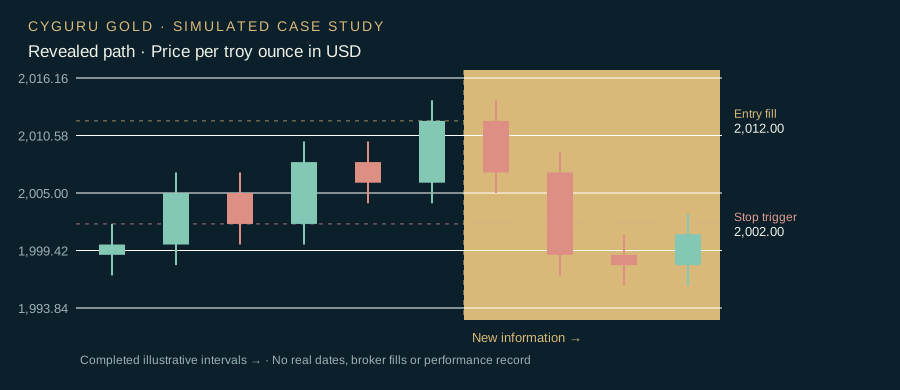
The revealed case record stipulates an exit of all four ounces at 1,998. Gross is 4×(1,998−2,012)=−USD 56; after USD 2 fees, net is −USD 58. This is USD 12 worse than the USD 46 planning estimate. The synthetic OHLC path illustrates the price movement but the exit price comes from the stipulated fill record, not an assertion that all stops fill at the candle close.
Reproduce the calculation
| Component | Calculation or state |
|---|---|
| Planned estimate | USD 46 |
| Gross at 1998 | −USD 56 |
| Explicit fees | USD 2 |
| Net / estimate overrun | −USD 58 / USD 12 |
Use the case facts and their units. Chart movement alone does not prove execution or account cash flows.
What this case teaches
Keep the original estimate and the adverse realized result side by side. A planning threshold can govern new entries without guaranteeing the loss on exposure already in the market.
Your reviewed scenarios are saved in this browser.