The old signal has expired
Recognize that a delayed entry changes both permission and price-to-stop risk.
Illustrative simulation · No historical performance claim01. Read the information available.
The original long event was timestamped ninety seconds ago with reference 2,000. The latest executable ask in the case facts is 2,006. The written entry window lasts sixty seconds and permits an ask no higher than 2,001. Five ounces were considered in the old price-only comparison, but no order was submitted.
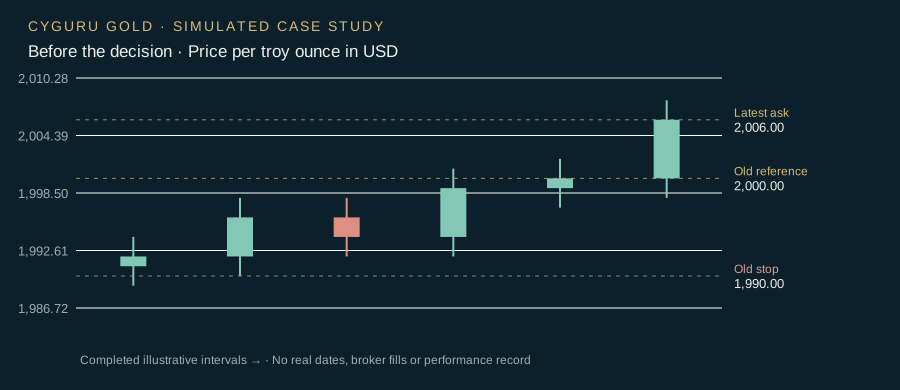
02. Apply the documented plan.
An expired signal grants no new-entry permission. Record the missed opportunity and wait for a fresh eligible decision. If a later rule permits an entry, size must be calculated using its own current evidence and capacity.
No authorized entry, despite a later advance
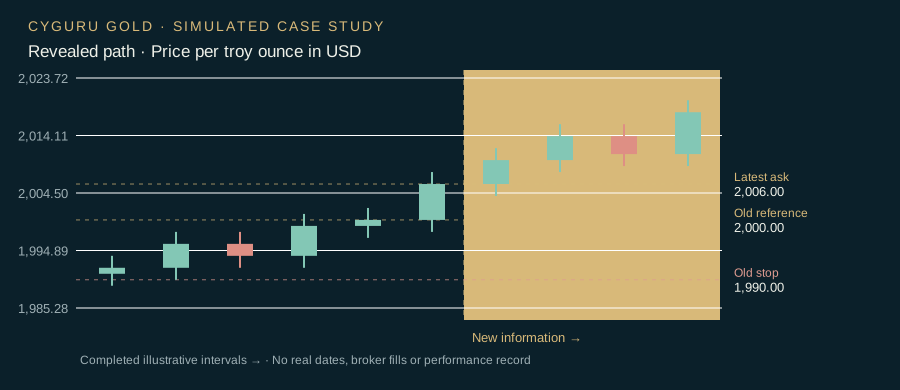
The synthetic continuation rises. That attractive ending does not turn the late order into a compliant action. The price-only exposure would have been 5×10=USD 50 at the old reference versus 5×16=USD 80 at the late ask, a USD 30 or 60% increase. No trade was placed under this case policy, so no realized profit or loss is assigned.
Reproduce the calculation
| Component | Calculation or state |
|---|---|
| Validity | 60 seconds; ask ≤2001 |
| Observed delay / ask | 90 seconds / 2006 |
| Old / late price risk | USD 50 / USD 80 |
| Increase | USD 30; 60% |
Use the case facts and their units. Chart movement alone does not prove execution or account cash flows.
What this case teaches
A missed gain is not a debt the next trade must repay. Preserve the expired event and separate hypothetical opportunity analysis from the executed account ledger.
Your reviewed scenarios are saved in this browser.