The setup qualifies, but which size fits?
Calculate a feasible whole-ounce size after execution allowance and explicit fees.
Illustrative simulation · No historical performance claim01. Read the information available.
The last completed synthetic candle closes at 2,000. Assume every setup gate passes and no exposure is already reserved. The instrument in this exercise allows whole ounces only. The later chart is hidden; it cannot supply evidence about future fills or whether the setup has positive expectancy.
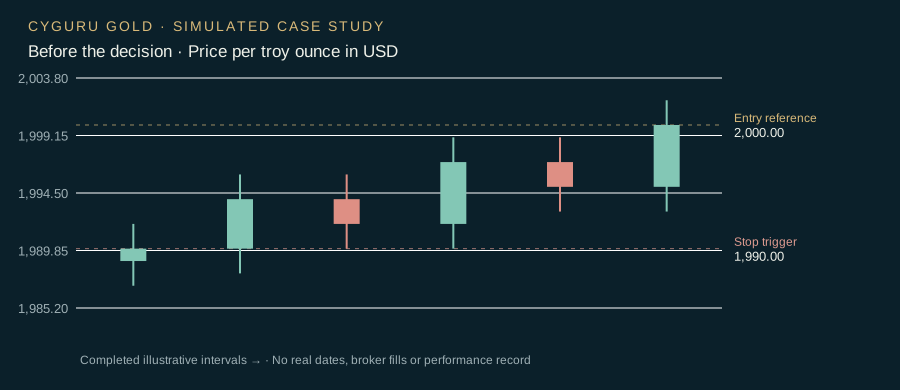
02. Apply the documented plan.
Use a USD 50 planning budget. The ten-dollar entry-to-stop distance is augmented by a USD 1 per ounce adverse-execution allowance and USD 0.20 per ounce proportional round-trip explicit fees. Neither allowance nor fee is included elsewhere. Round quantity down to the permitted whole-ounce grid; the estimate is not a maximum-loss guarantee.
Four ounces fit the planning model
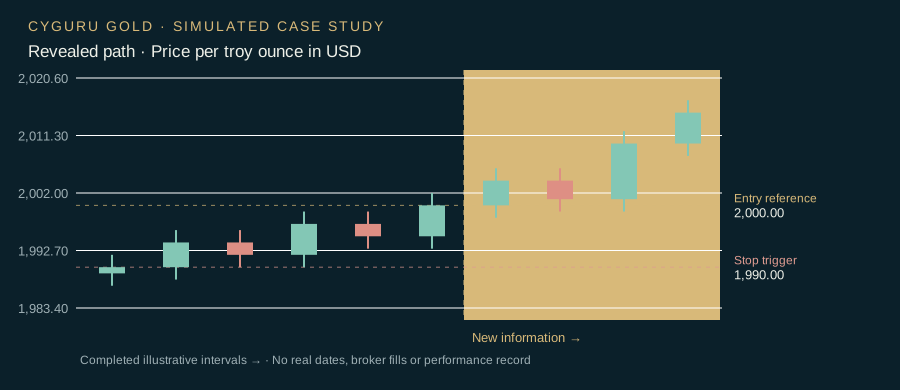
Estimated risk per ounce is 10+1+0.20=USD 11.20. The continuous quotient is 4.4643 ounces; rounding down gives four ounces and USD 44.80. The subsequent synthetic advance does not change which size was permitted at the cutoff. No executed-trade P&L is assigned because this exercise specifies a sizing decision rather than a complete fill and exit ledger.
Reproduce the calculation
| Component | Calculation or state |
|---|---|
| Price distance | USD 10 / oz |
| Allowance plus fees | USD 1.20 / oz |
| Four ounces | USD 44.80 estimated risk |
| Five ounces | USD 56; rejected |
Use the case facts and their units. Chart movement alone does not prove execution or account cash flows.
What this case teaches
Sizing permission and forecast confidence are different. Keep the unused planning allowance distinct from actual realized costs, and recalculate if executable entry or capacity changes before submission.
Your reviewed scenarios are saved in this browser.