One candle touches both exits
Recognize when OHLC evidence cannot establish whether a stop or target executed first.
Illustrative simulation · No historical performance claim01. Read the information available.
A synthetic one-ounce long is stipulated filled at 2,000 before the hidden next bar. The stop is 1,990 and target 2,010, with mutually exclusive exit handling assumed for this exercise. You must choose a reporting rule before seeing the next candle. Intrabar order is not available from the OHLC data source.
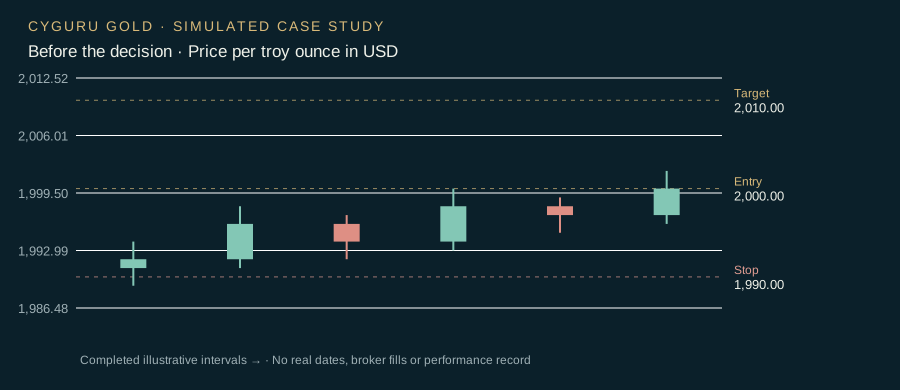
02. Apply the documented plan.
Use the evidence that actually exists. If one candle touches both exits without a finer execution record, label the economic result unresolved under this source, or report explicitly separated conservative and favorable scenarios. Do not choose a winner from the candle color. Total explicit fees for either modeled alternative are USD 1.
Both exits touched; sequence not established
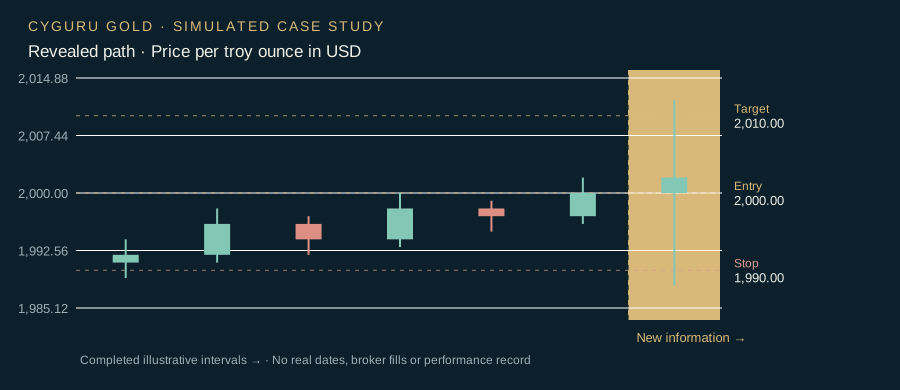
The revealed next bar is O=2,000, H=2,012, L=1,988, C=2,002. Both stop and target lie within its range. Under stipulated exact level fills and USD 1 fees, stop-first would be −USD 11 net and target-first +USD 9 net. Those are separate modeled alternatives, not confirmed actual results and not a probability distribution. The single candle cannot establish which occurred first.
Reproduce the calculation
| Component | Calculation or state |
|---|---|
| Hidden bar OHLC | 2000 / 2012 / 1988 / 2002 |
| Stop-first alternative | −10−1 = −USD 11 |
| Target-first alternative | +10−1 = +USD 9 |
| Observed chronology | Unknown |
Use the case facts and their units. Chart movement alone does not prove execution or account cash flows.
What this case teaches
Preserve the ambiguity rather than using a profitable close to invent favorable fills. A conservative simulation convention can be useful, but its convention must remain distinct from observed execution evidence.
Your reviewed scenarios are saved in this browser.