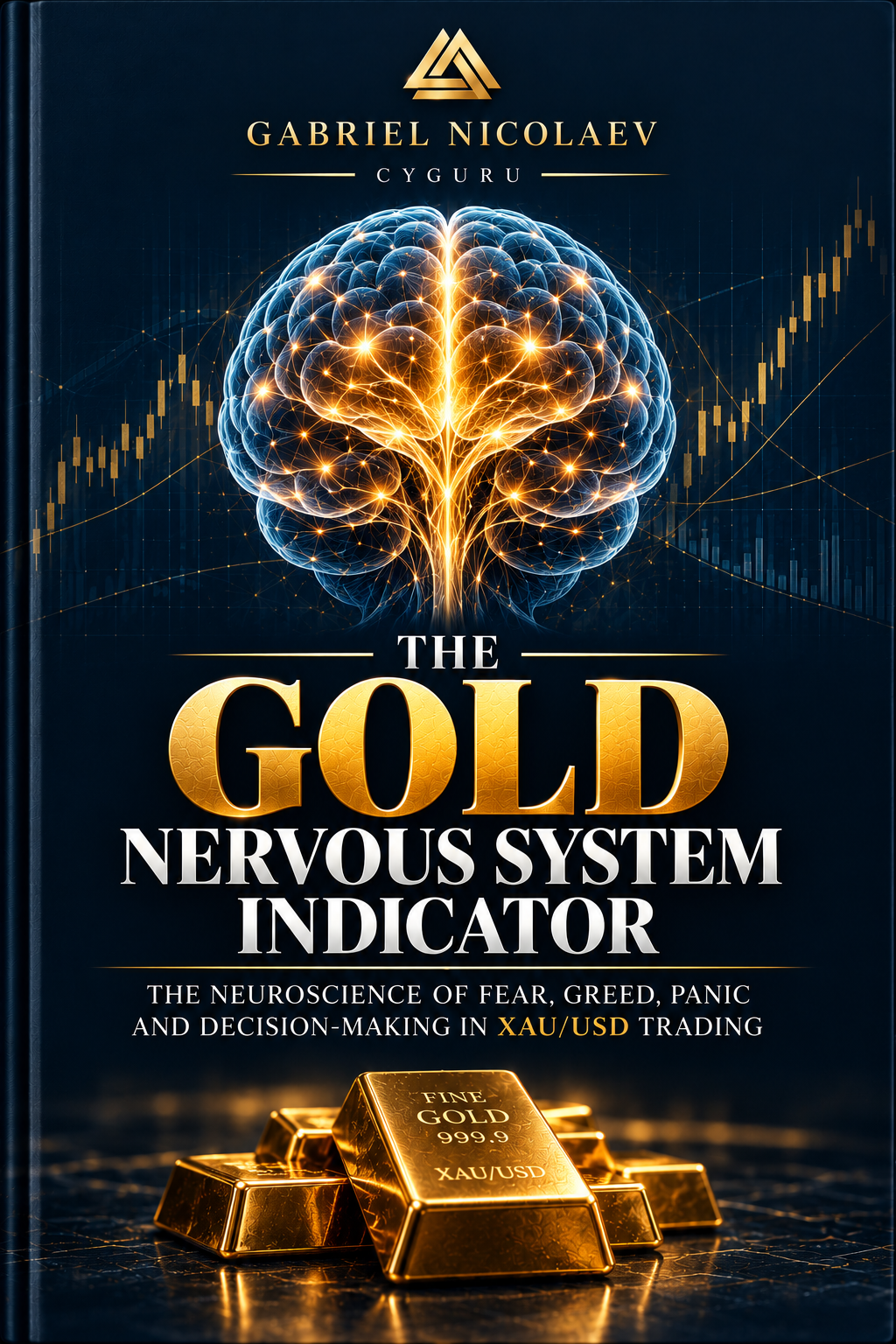
Follow the connection between each free course module and an optional book by Gabriel Nicolaev — CyGuru. Recommendations reflect the books’ published descriptions and the module topics; they do not claim that every course procedure appears in a particular chapter.
Module 01 · Lessons 1–6Market foundations
Gold Trading Mastery
The book introduces gold-market fundamentals, technical analysis and the discipline of constructing a trading process. Use it to extend the introductory vocabulary after the worked course examples.
Apply: Write the instrument, quote unit and order assumptions in your own words.
Module 02 · Lessons 7–12Risk & execution
The Gold Trader’s Code
The handbook connects setup evidence, invalidation, position sizing and trade management. Pair that rule-based approach with this module’s explicit exposure calculations.
Apply: Convert one broad risk principle into a condition that can block an order.
Module 03 · Lessons 13–18Conditions & review
The Gold Trader’s Code
The book’s price-action and strategy material gives a broader setting for trends, ranges and failed breaks. The course supplies worked examples for testing the assumptions you choose.
Apply: Define the eligible condition and one observation that would invalidate the interpretation.
Module 04 · Lessons 19–24Execution & evidence
The Gold Trader’s Code
The handbook combines risk management and case studies with disciplined evaluation. Use that structure to organize the module’s execution, combined exposure and review questions.
Apply: Keep setup permission, actual fills and net outcome in separate journal fields.
Module 05 · Lessons 25–29Physical gold & price references
Gold Trading Mastery
The broad gold-market course provides context for studying the instrument behind a quote. Keep this module’s purity, custody and premium calculations as the explicit worked reference.
Apply: Compare two offers only after aligning units, fineness, currency and ownership terms.
Module 06 · Lessons 30–34Instruments, data & portfolio decisions
Gold Trading Mastery
The book’s market framework complements the study of gold instruments and portfolio decisions. Reconcile the contract, fund or holding before interpreting its displayed return.
Apply: Explain the cash-flow and exposure differences between two gold-labelled instruments.
Module 07 · Lessons 35–39Indicators & chart data
The Gold Trader’s Code
The handbook discusses technical tools alongside market context, entry conditions and risk. That is the relevant bridge to this module’s emphasis on chart inputs and signal timing.
Apply: Document what an indicator measures and what additional evidence your decision requires.
Module 08 · Lessons 40–44Signals & performance records
The Gold Trader’s Code
The book treats signals as decisions whose context and limitations matter. Use the free course lessons for the specific alert, webhook and return-accounting checks.
Apply: Trace one signal from its original timestamp to a distinct confirmed execution record.
Module 09 · Lessons 45–49Quantitative evidence & stress
Gold Trading Mastery
The book’s quantitative-research perspective provides a broader reading direction. This module’s formulas and assumptions remain the direct reference for volatility, correlation, event studies and stress examples.
Apply: State one measurement assumption and one conclusion the statistic cannot support.
Module 10 · Lessons 50–54Options & conditional gold exposure
Gold Trading Mastery
The wider course connects fundamentals and advanced trading analysis. Pair that context with the free module’s precise option, roll and mining-business examples rather than treating a gold label as a single payoff.
Apply: Write the unit, sensitivity and cash obligation before comparing two products.
Module 11 · Lessons 55–59Indicator definitions & decision timing
The Gold Trader’s Code
Technical analysis becomes more useful when its observations lead to explicit permission and risk conditions. Read the handbook alongside the module’s input and timing audits.
Apply: Turn one indicator observation into a testable predicate with a declared information cutoff.
Module 12 · Lessons 60–64Position state & execution diagnostics
The Gold Trader’s Code
The book’s trade-management and case-study orientation complements a complete program ledger. Use this module’s examples to separate exposure, fills, excursions and costs.
Apply: Reconcile one program’s intended quantity, confirmed fills and final net outcome.
Module 13 · Lessons 65–69Contract mechanics & relative prices
Gold Trading Mastery
A broad gold-market framework is useful background for contract activity and relative prices. Keep the module’s stated instrument definitions and arithmetic visible when assessing a narrative.
Apply: Explain why a contract count or relative-price change is not automatically a directional signal.
Module 14 · Lessons 70–74Physical evidence & hedge practice
Gold Trading Mastery
The book places market knowledge and risk in one educational framework. This module adds worked physical-evidence, inventory and currency scenarios that should retain their own assumptions.
Apply: Prepare a scenario report separating metal quantity, basis, currency, costs and liquidity.
Module 15 · Lessons 75–79Performance metrics & uncertainty
Gold Trading Mastery
The quantitative-research direction is a useful next reading step after the worked metrics. Keep formula conventions, sample limitations and sequence dependence explicit in your own report.
Apply: For one reported ratio, name the numerator, denominator, frequency and assumptions.
Module 16 · Lessons 80–84Research design & evidence audits
Gold Trading Mastery
The wider research framework complements the course’s focus on testing and evidence. Use the module’s source-linked examples for specific resampling, historical-universe and performance-audit procedures.
Apply: Record the selection history and specify which observations were genuinely held out.
Module 17 · Lessons 85–90Build the complete paper system
The Gold Trader’s Code
The handbook’s rules and case studies complement the construction workshop. Use them to question the coherence of the charter while preserving the free workshop’s test sheets and operational records.
Apply: Have another reader apply your written rules to the same boundary-test inputs.
Module 18 · Lessons 91–95Execution discipline & decision quality
Before You Click
Before You Click examines late entries, recovery pressure, unplanned additions, emotional exits and the difficulty of following justified limits. It is the direct companion to this module’s execution-behavior exercises.
Apply: Record the action you wanted to take and the specific condition that governed the authorized action.
Module 19 · Lessons 96–100Integrated cases & final project
The Gold Trader’s Code
The handbook’s case-study approach complements the integrated synthetic cases. Review what was knowable before the decision, then reconcile fills, costs and uncertainty after it.
Apply: Complete the lesson-100 evidence package, including a compliant loss and a valid no-trade decision.